Anthony Carlyle interviewed Erik Van Woensel, a homeopath who demands rigorous scientific accountability, standardisation, and long-term diagnostic tracking of homeopathy. He introduced more than 150 detailed, long-term case studies, citing systematic analyses, quantitative follow-ups, and transparent prognostic breakdowns to establish strict clinical standards. Click to read more…

Health
Change: One Heart At a Time – Part 2
All over the world, people suffer physically, psychologically, and spiritually due to socio-economic want and disparities. The root cause of problems lies in unbalanced psychic urges. Both exploiters and the exploited suffer from imbalances, each in their ways. Unless the socio-economic system takes the physico-psycho-spiritual makeup of human beings properly into account, this suffering will continue to disturb and destroy not only human beings but the entire living world and its environment. Click to read more…
Obsessive Clinging (abhinivesha): A Perspective on Addiction from Yoga Psychology
Overlapping with the modern idea of “addiction”, the concept of abhinivesha — obsessive clinging — is present in psychological analyses in Buddhist philosophy, Yoga Darshana, Ayurveda, and other systems of classical Indian medicine. Click to read more…
Change: One Heart At a Time – Part I
All over the world, people suffer physically, psychologically, and spiritually due to socio-economic want and disparities. The root cause of problems lies in unbalanced psychic urges. Both exploiters and the exploited suffer from imbalances, each in their ways. Unless the socio-economic system takes the physico-psycho-spiritual makeup of human beings properly into account, this suffering will continue to disturb and destroy not only human beings but the entire living world and its environment. Click to read more…
The Five P Health Model
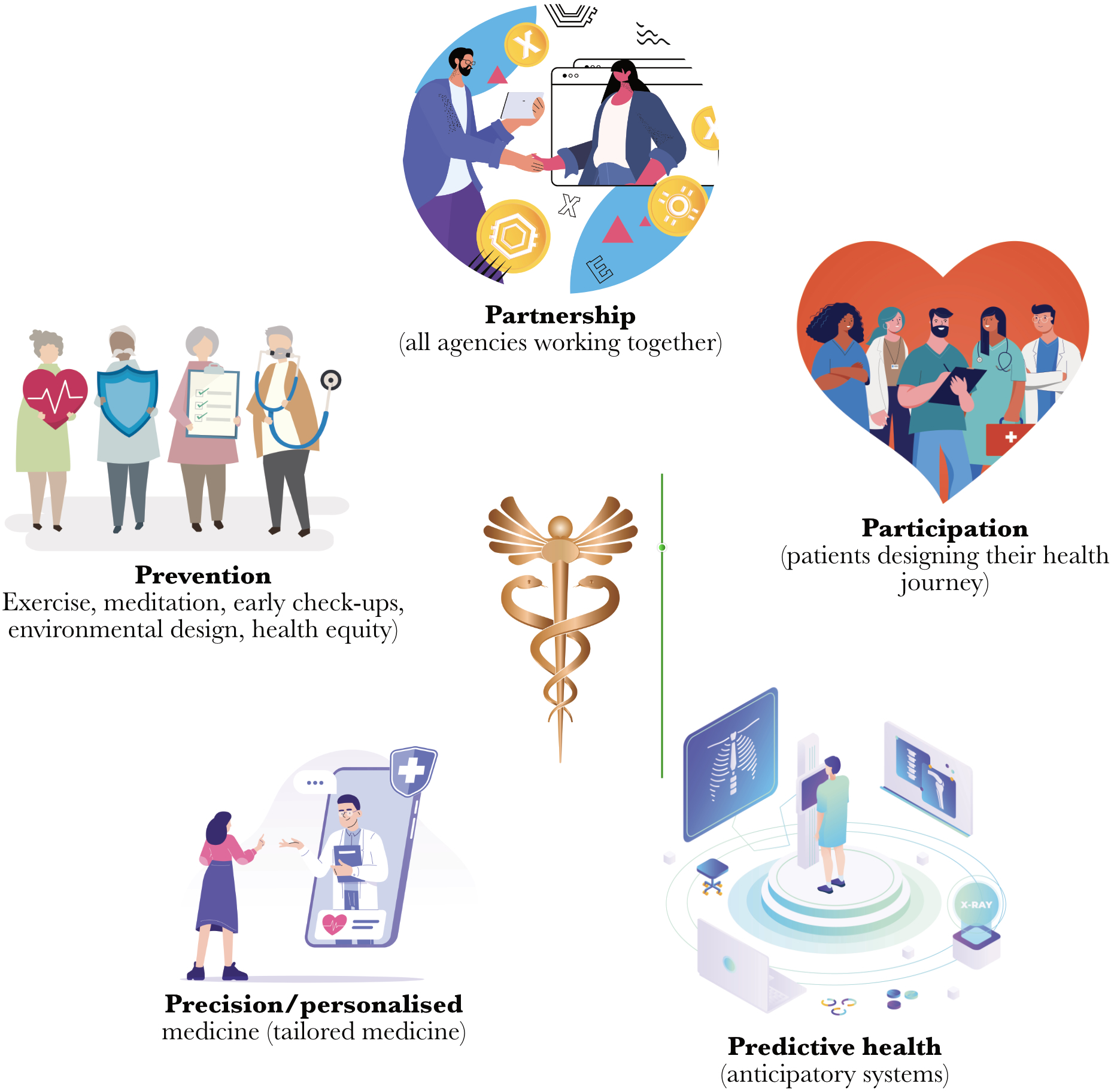
While the traditional model of medicine is not likely to disappear as reactive medicine is built into the system, we are seeing weak signals of another approach, the 5P emerging. The 5p model consists of Prevention (exercise, meditation, early check-ups, environmental design, health equity); Precision/personalized medicine (tailored medicine); Predictive health (anticipatory systems); Participation (patients designing their health journey); and Partnership (all agencies working together). Click to read more…
Power and Medicine During Transitional Eras: Microvita As the Bridge
Starting with a genealogical gloss on the decline of the Ayurvedic system in South Asian history, this essay argues for an alternative vision of the future of health: a holistic model that includes global health cooperatives and integrates spirit with science. Shrii Prabhat Ranjan Sarkar’s theory of microvita serves as a conceptual framework for taking placebo and nocebo seriously. While we imagine a rosy future, we are clear that the transition we are in now will bring morbid symptoms and systems. Click to read more…
The Human Right to Health
While Planetary Health and One Health still centre on human health, they represent some of the first attempts to expand the underlying spirit of humanism to other animate and inanimate entities in global academic and policy spheres. The time is ripe for a new ethical and philosophical viewpoint for all of humanity to reassess its relationship with the rest of the world, one which expands the spirit of humanism to everything, animate and inanimate, such as neohumanism. Click to read more…
Shukra, The Totipotent Sap
Shukra is an ancient concept. The main system of Indian indigenous medicine, the ancient Ayurveda, identifies shukra as the final essence of all other bodily elements: “A person who has healthy shukra has a brightness of confidence, with eyes and skin that seem to radiate light.” According to Ayurveda, shukra is the final of the seven tissues, each resulting from the transformation or sublimation of the preceding tissue. Click to read more…