

By Shrii Prabhat Ranjan Sarkar
According to many scholars, the first expression of creation took place not on land but in water. Living protoplasm, thoroughly drenched in carbon materials, appeared as a unicellular entity, as kaoshikii sattá, for the first time in water.
In water, the unicellular entity, or elementary cell, evolved into multicellular entities, or compound cells. Then, in the ascending phase of evolution, some of those creatures had to move onto land because of environmental needs, while others found opportunities for development in water. Even in water, they were born from eggs. After leaving the water, they became reptiles. Those reptiles, still oviparous, developed into higher forms of creatures. They evolved into mammals.
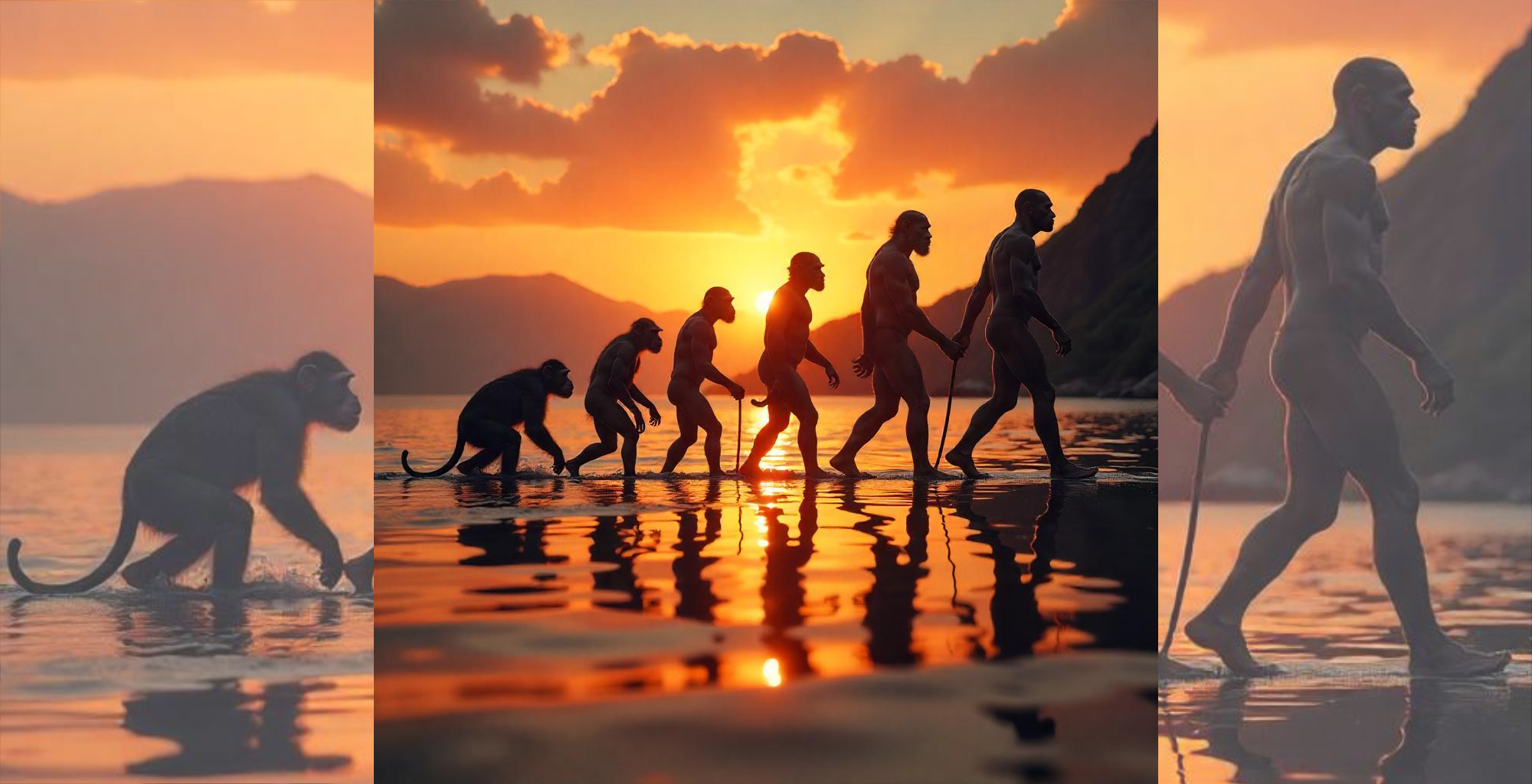
Higher forms of these reptiles became winged creatures – vihauṋga, or birds. The quadruped mammals living on land learned to climb on trees and developed into shákhámrga[tree animals, that is, ape-men or proto-apes]. The ape-men, climbing further up the ladder of evolution, developed into Australopithecine, proto-human apes. [Some] mrga[quadruped land mammals], after further development, became known as shákhámrga.
[Some] shákhámrga were the half-human or anthropoid apes (like gorillas, chimpanzees and orangutans). These anthropoid apes gradually developed into men with pigtails and sacred threads, into men with coats and pants or suits, and, in a further course of forward journey, into enlightened mahápuruśas [great personalities] wearing clothes.
Animals are chiefly of two types: graminivorous (feeding on grasses and cereals) and carnivorous. Graminivorous animals usually have hooves and no paws, while carnivorous animals have paws. Graminivorous animals have sparkling white teeth which are carefully arranged. Carnivorous animals have uneven teeth, slightly yellowish or reddish-yellow in colour. They have canine teeth on both sides of the mouth for tearing flesh. Among granivorous animals, particularly those creatures belonging to the zebu species (or bison genus), there was an ability to store food in their appendix.
This developed in ancient times, when they lived in a volatile situation and were unsure of obtaining food at all times. Apes, humans and goats all developed this capacity. Cows and buffaloes also did, and they still do today. As life becomes more secure, the need for this appendix also diminishes. This has happened to humans, apes and certain other animals. During leisure time, by regurgitating food from the appendix, these animals make it fit for digestion with the help of saliva. In English, this is called rumination or chewing the cud; in Bengali, it is called románthanorjábar kát́á. Carnivorous animals do not have this capacity because the meat they eat decomposes quickly and develops a foul odour. It cannot be used for rumination or for chewing cud.
In ancient times, land-dwelling, graminivorous animals without horns or claws for self-preservation began to climb trees for safe refuge. For those animals, just as the need to use hooves ended, they felt the need to use their forelimbs to hold onto tree branches. They used their hind legs partly to clutch and partly to run. They used their forelimbs to clutch tree branches, as well as for other tasks.
In ancient times, the forelimbs were earlier called kara, and later hasta. Australopithecines, creatures of the ape family, and human beings are all equipped with kara. In fact, they have four limbs, but humans are not quadrupeds because they use their forelimbs to clutch objects. To climb trees and leap up, the creatures of the ape family needed a tail.
However, for the more intelligent members of this family who no longer needed to leap as much, the lymphatic gland’s importance diminished, and their tails dropped off. This superfamily of creatures – the apes – gradually split into two family lines. Both families had well-arranged teeth and no canine teeth. Both had an intestinal appendix, but one family had a tail, and the other was tailless.
Those with tails, belonging to the ape family, are called monkeys – in Bengali bánarorbádar, and the females bánariiorbádarii, in Urdu bandar, and the females bandariá. The tailless monkeys had greater intellectual development than those with tails. They also evolved into two different classes: one ordinary and the other more developed.
Of the ordinary tailless apes there were again three distinct genera: 1) gorillas, 2) orangutans (in Malay language it means “men of the trees”) and 3) chimpanzees. Today the developed, tailless apes are known as humans. The word “man” stands for “mentally developed ape”. This is how we differentiate the types of graminivorous animals.
Humans are naturally vegetarian creatures without a developed intestinal appendix. So regular intake of meat might cause the ailment of appendicitis in humans – this does occur often. Regular meat intake is an unnatural habit for humans and provides no benefit.
At the slightest occasion, whether out of fear or excitement, a monkey grimaces with clenched fists. This habit is prehistoric. Although the ancestors of human beings and monkeys are the same, they were separated at least one million years ago. So a human being also, when frightened or excited, clenches a fist and grimaces. A small child keeps its fist clenched most of the time, and the habit of grimacing also remains predominant in childhood.
Some animals live in herds or groups, and others live by themselves. Sheep, lions, and elephants live collectively, but goats, tigers, and cats live separately, on their own. Yes, the creatures of the ape group also live collectively. All creatures with herd instinct have a leader. They do not have any form of milita netrtva [collective leadership] amongst themselves. This is because collective leadership ultimately creates fissures in the saḿgha [an association or organisation or society], and this goes against the very nature of existence.
The human being is also a creature that leads a collective life. However much one might use vocal pyrotechnics or speak eloquently against hero-worship, in their hearts, humans have always longed for strong and firm leadership. They are collective-minded creatures; if one finds an ideal leader, one offers all one’s love and devotion to them on the one hand, and on the other hand does not hesitate to face death willingly at their command. This inner characteristic of human thinking keeps one’s mind and heart always fulfilled. Even those who oppose hero-worship do so only verbally, not from the core of their heart.
In any case, the apes are a group of creatures associated with humans. Like humans, they have herd instinct and unlimited love and devotion for their leader. When the leader becomes old, he or she hands over the leadership to a younger monkey and retires. Whether they are red-faced, dark-faced or small-sized monkeys or baboons, they will have a leader. Since very ancient times, the word gabayawas has been used to describe a monkey leader. In spoken Bengali, we call this gabaya viir hanumán.
There are several hundred species of monkeys. They are diverse in appearance and nature. Some are calm and quiet, gentle and disciplined, and others are very brave. Some have brown faces and colour, others are black, and still others are red. Among the red-faced monkeys, the smaller ones are called ulluk in Sanskrit. They are very intelligent.
Depending on their stage of evolution, monkeys vary in vocabulary size. Some have only two to four hundred words in their language, while others have six to seven hundred. There is very little difference between the vocabulary size of extremely underdeveloped humans and that of highly developed monkeys. This means that if developed monkeys add to their vocabulary, it would come close to the language of underdeveloped humans. Judging by their language, the developed monkeys with tails are more advanced than the tailless monkeys (gorillas, chimpanzees and orangutangs). Overall, of course, orangutans have more advanced intelligence.
In physical strength, none can compare with the gorillas. Among these apes, those with tails, which are more powerful – those dark-faced monkeys – are called hanumán in spoken Bengali, and in northern India, languor. They have great physical strength. Male apes are called viir hanuman in colloquial language.
Excerpted from Birds and Animals-Our Neighbours, Shrii P R Sarkar, pp. 20, 225. Ananda Marga Publications.
Published in Neohumanist Review, Issue 5, September 2025, pp 38-39, 56.