

By Pranav Bihari
Pranav Bihari studied Political Sociology at the London School of Economics and holds a PhD in Sociology. Based in Berlin, he is an independent researcher writing on political and economic sociology, with a longstanding engagement with the PROUT movement and Neohumanist thought.
Abstract
Contemporary political economy has developed a significant body of scholarship on predistribution (the argument that market rules and institutional structures should be shaped upstream to prevent extreme concentrations of wealth and power, rather than corrected downstream through taxation and welfare transfers). This article maps the relationship between that scholarship and Sarkar’s neohumanist political economy. Its scope is deliberately focused on one question: how economic institutions should be designed to prevent and manage inequality, rather than offering a comprehensive comparison of theories of why inequality develops or why it is problematic. Within that scope, it identifies three points of convergence between the predistribution literature and neohumanist political economy — on economic concentration as domination, on the political character of market rules, and on the principle of managed inequality — while arguing that the predistribution literature, operating within a liberal-individualist and anthropocentric framework, cannot theorise the ecological embeddedness of economic life, the civilisational consequences of accumulation as a dominant social value, or the extension of ethical concern to all animate beings that neohumanism places at the centre of its vision. Neohumanism, grounded in the expansion of love to all animate life and the unity of humanity, provides the normative foundation that predistribution scholarship needs but cannot generate from within its own framework.
I. Two Traditions, Converging Concerns
Within mainstream political economy, a significant shift has been taking place. Researchers and theorists who study inequality (why it grows, what sustains it, what might be done about it) have increasingly moved away from asking how wealth should be redistributed after markets produce their outcomes, toward asking a more fundamental question: how do the rules and structures of markets generate extreme concentrations of wealth and power in the first place? This shift has produced a body of scholarship gathered under the concept of predistribution, the idea that democratic societies should shape the institutional architecture of economic life upstream, before concentration hardens, rather than attempting to correct it downstream through taxation and welfare transfers alone.
Sarkar’s students will recognise the terrain immediately, even if the vocabulary is unfamiliar. The critique of accumulation as a structural problem rather than merely a distributional one, the insistence that economic arrangements reflect political choices rather than natural laws, the conviction that human welfare cannot be achieved by correcting surface outcomes while leaving underlying structures intact: none of these are novel positions within neohumanist thought. What is novel, and what may be of real value for those working within the Sarkar tradition, is the independent path by which contemporary political economy has arrived at closely related conclusions, the empirical and institutional specificity it has developed along the way, and the precise points at which it stops short, and why.
This article offers that mapping. It does not re-explain Sarkar’s philosophy or rehearse the principles of PROUT (the Progressive Utilisation Theory, the socioeconomic framework that follows from neohumanism) for an audience already familiar with them. Its scope is deliberately focused. There are at least three distinct questions one might ask when comparing these traditions: why does inequality develop in the first place; why is it a problem; and how should economic institutions be designed to prevent or manage it. This article addresses the third question primarily. It does not attempt a comprehensive comparison of causal theories of inequality, nor a full analysis of the divergences and convergences on why inequality matters, both of which would require substantially more development than a single article permits. Instead, it traces what the predistribution literature has established about institutional design and the prevention of concentration, where this converges with neohumanist political economy, and where neohumanism, particularly through its grounding in expanded love, ecological embeddedness, and the unity of all life, addresses problems that predistribution theory, operating within a liberal-individualist framework, cannot adequately reach. It should also be noted from the outset that the distinction between predistributive and redistributive approaches is one of emphasis and thrust rather than categorical separation. Many institutional instruments operate in both registers simultaneously, and most serious political economists combine elements of both. The argument here is not that one must choose between them, but that the predistributive emphasis, on shaping the rules of economic life before extreme concentration occurs, represents a more fundamental and durable approach to the problem of inequality.
II. What the Predistribution Scholarship Has Found
The concept of predistribution was given its clearest political articulation by the American political scientist Jacob Hacker, who defined it as the effort to shape the distribution of economic power and rewards through market rules themselves, before governments collect taxes or pay out benefits, rather than correcting market outcomes after the fact (Hacker, 2011). The insight was primarily strategic: Hacker observed that as economic power concentrates, the political capacity to sustain redistribution erodes alongside it. Affluent groups acquire disproportionate influence over tax policy, regulatory bodies, and public discourse, steadily weakening the mechanisms through which redistribution is financed.
Predistribution addresses this dynamic at its source, by restructuring labor law, corporate governance, competition policy, and property rights before extreme concentration entrenches itself politically.
This argument drew upon a longer tradition in liberal political philosophy. John Rawls had argued that a just society requires not merely the redistribution of income but the wide dispersal of productive assets (capital, land, and access to education) as the background conditions for fair cooperation among equals (Rawls, 1971). The economist James Meade similarly argued that substantive democratic freedom required broadly distributed ownership rather than merely welfare transfers, since economic dependency upon concentrated ownership structures limits substantive freedom regardless of formal political rights (Meade, 1964). Together, this tradition insists that the preconditions of democratic life are economic and institutional, not merely procedural.
The more recent empirical literature adds a detailed account of how thoroughly contemporary capitalist economies have moved in the opposite direction. Thomas Philippon’s comparative research has documented the dramatic reversal of competitive intensity across major industries in the United States relative to European economies, a reversal produced not by market forces but by the weakening of anti-monopoly enforcement and the growing political influence of dominant firms (Philippon, 2019). Tim Wu and Lina Khan have traced how digital platform economies generate structural tendencies toward concentration, where network effects, data accumulation, and financial leverage allow dominant firms to consolidate positions that new entrants cannot challenge, and how the legal frameworks designed to prevent such concentration have been progressively dismantled or reinterpreted (Wu, 2018; Khan, 2017). Martin Gilens and Benjamin Page’s influential study of American politics found that policy outcomes correlate strongly with the preferences of economic elites and large interest groups, while the preferences of ordinary citizens have near-zero independent influence when they diverge from elite preferences, a finding that holds across issue areas and political administrations, and whose implications extend far beyond the United States (Gilens & Page, 2014). In practice, this means formal democratic equality coexists with substantive political inequality: one person, one vote, but concentrated wealth shapes which choices appear on the ballot in the first place.
The picture that emerges is of economic systems justified through the promise of competitive dispersal of opportunity but operating in practice through self-reinforcing concentration of wealth, institutional power, and political influence. Several mechanisms drive this. Dominant firms can externalize costs (environmental, social, labor) onto the broader public in ways that smaller, more accountable actors cannot. Financialized systems oriented toward short-term shareholder returns systematically discourage long-term productive investment in favor of speculative accumulation and stock buybacks (Lazonick, 2014). And concentrated ownership of productive resources creates a class of actors with strong incentives to resist regulatory reforms that would reduce their advantages, and with sufficient political leverage to do so. Economic power and political power become mutually reinforcing in ways that make purely redistributive corrections, even when achieved, increasingly fragile and reversible.
The policy directions that follow from predistribution thinking include: stronger anti-monopoly enforcement to preserve competitive markets; broader access to productive capital through public investment institutions and cooperative finance; worker representation in corporate governance through codetermination models; wage floors and labor market institutions that restore bargaining power to workers; and progressive taxation designed not only to raise revenue but to discourage the accumulation of wealth at scales sufficient to distort democratic institutions. These are institutional proposals rather than compensatory ones, aimed at the structure of markets rather than at their outputs. Versions of them operate, in partial and imperfect form, across various existing economies. Germany’s codetermination system legally requires that workers hold half the seats on supervisory boards of large corporations, giving employees direct institutional voice over strategic decisions including investment, executive pay, and restructuring, not as a concession granted by owners but as a right embedded in corporate law (Hall & Soskice, 2001). The Mondragon cooperative network in the Basque Country of Spain, comprising over a hundred worker-owned enterprises across manufacturing, retail, and finance, demonstrates that large-scale economic activity can be organized around democratic ownership and shared governance without sacrificing productive capacity (Malleson, 2014). Nordic sovereign wealth arrangements partially socialize returns from collectively owned natural resources, distributing them across the population rather than concentrating them among private owners. None of these models is without limitations, but together they illustrate that the institutional architecture of market economies is far more open to democratic design than mainstream economic discourse typically assumes.
III. Where the Traditions Converge
For those working within the Sarkar tradition, the predistribution literature offers something valuable: independent empirical and institutional confirmation of a critique that neohumanism has long advanced from philosophical and ethical grounds. The convergence is real and runs deep, and identifying it precisely helps both understand what mainstream scholarship has established and locate where neohumanist thought provides what that scholarship cannot.
The most fundamental point of convergence is the understanding of economic concentration as a form of domination rather than merely uneven distribution. Neohumanism has always held that the concentration of wealth in the hands of a few (what Sarkar called the rule of vaeshyas, the acquisitive class) produces not just material inequality but structures of social power that corrupt democratic life, distort cultural values, and degrade the conditions of human development (Sarkar, 1982). The predistribution literature arrives at closely related conclusions through institutional and empirical routes. When Hacker and Paul Pierson demonstrate that concentrated wealth translates systematically into disproportionate political influence (Hacker & Pierson, 2010), or when Jeffrey Winters documents the political sociology of oligarchy as a distinct mode of rule that persists within formally democratic systems (Winters, 2011), they are providing the empirical architecture of a critique that Sarkar articulated in philosophical terms. The language differs; the structure of the argument does not.
A second convergence concerns the political character of market rules. One of neohumanism’s consistent insights has been that economic arrangements are social constructions, expressions of values, power relations, and structural choices, rather than natural outcomes of human behavior. PROUT’s insistence on democratic governance of economic life, on the social accountability of productive institutions, and on the priority of collective welfare over private accumulation reflects this understanding (Sarkar, 1982; Inayatullah, 1999). The predistribution literature has been making essentially this argument within mainstream political economy: markets are not naturally occurring mechanisms operating independently of political and legal institutions, but are structured through property law, financial regulation, labor policy, and public investment in ways that reflect, and can be changed by, political choices. When labor law is weakened, when anti-monopoly enforcement is relaxed, when financial regulation is rolled back, these are not market forces operating freely. They are political decisions made under pressure from concentrated interests, with distributional consequences that are neither accidental nor inevitable. For Sarkar’s students, it is confirmation that the political economy establishment has moved substantially toward a position neo-humanism has held for decades: that the question is never whether economic life will be governed, but by whom and in whose interest.
A third convergence lies in the principle of managed rather than unbounded inequality. Sarkar’s PROUT framework does not advocate for absolute economic equality, which would eliminate differentiation in contribution, responsibility, and productive role. Instead it proposes rational distribution, ensuring that the minimum standard of living rises continuously, that basic needs are met for all, and that the ratio between minimum and maximum accumulation remains within socially sustainable bounds, without fixing a rigid ratio that ignores context (Sarkar, 1992). The Rawls-Meade tradition converges with this on the floor side: Rawls’s difference principle insists that inequalities are only justifiable if they benefit the least advantaged (Rawls, 1971), and Meade’s emphasis on broadly distributed productive assets similarly targets the bottom of the distribution and the background conditions of fair competition (Meade, 1964). The predistribution literature’s emphasis on labor market institutions, cooperative ownership, and anti-monopoly enforcement likewise works primarily to raise the floor and prevent runaway concentration (Hacker, 2011; Hacker & Pierson, 2010).
Where Sarkar goes further than either tradition is on the ceiling. An explicit upper limit on private accumulation, the principled insistence that beyond a certain point accumulated wealth becomes a form of social domination rather than legitimate reward, is a distinctively neohumanist contribution that sits at the centre of PROUT’s institutional framework. It is fair to acknowledge that some debate about limits on accumulation exists within liberal political philosophy. Scholars working in the Rawlsian tradition have argued that the lexical priority Rawls assigns to the fair value of political liberties may imply limits on individual accumulation, since concentrated wealth undermines equal political standing (Freeman, 2007). And Ingrid Robeyns’s work on limitarianism has made the case for wealth ceilings more directly and with increasing force (Robeyns, 2019; 2024). These contributions are real and should not be dismissed.
However, they remain contested at the margins of liberal political economy rather than constituting a foundational commitment of the tradition. The mainstream predistribution literature, focused on labor market institutions, competitive markets, and asset dispersal, does not place an accumulation ceiling at the centre of its institutional proposals. For Rawls and Meade, the animating concern is whether the least advantaged are adequately provided for; for Sarkar, it is equally and explicitly whether the most advantaged are accumulating beyond what any just social order can permit. That difference in orientation, between a framework that generates ceiling arguments as a possible theoretical implication and one that treats the ceiling as a front-and-centre institutional commitment grounded in the prevention of domination, is real and significant. The predistribution literature does recognise accumulation as a source of political domination: Hacker and Pierson’s account of how concentrated wealth captures regulatory institutions and distorts public policy is precisely such an argument (Hacker & Pierson, 2010). But recognising accumulation as a threat to democratic institutions is not the same as theorising it as a form of civilisational or psychological domination.
By the latter, Sarkar means something more fundamental: that a social order organised around the maximisation of private accumulation does not merely concentrate wealth and distort institutions. It installs accumulation as the dominant value of social life itself, narrows the range of human aspiration, and produces a particular kind of person whose sense of self, status, and purpose is constituted through the possession and expansion of material wealth (Sarkar, 1982). This is domination not of one group by another in the political sense, but of a contracted vision of human possibility over a fuller one, a colonisation of human consciousness by acquisitive values that forecloses the development of love, solidarity, creativity, and spiritual depth.
The liberation Sarkar calls for in The Liberation of Intellect is from all such contractions, from the dominance of any single class, and from the narrow sentiments of geo-sentimentalism, religious parochialism, and nationalist identification that limit human solidarity, of which the grip of an economic culture organised around accumulation is one particularly powerful contemporary expression (Sarkar, 1982).
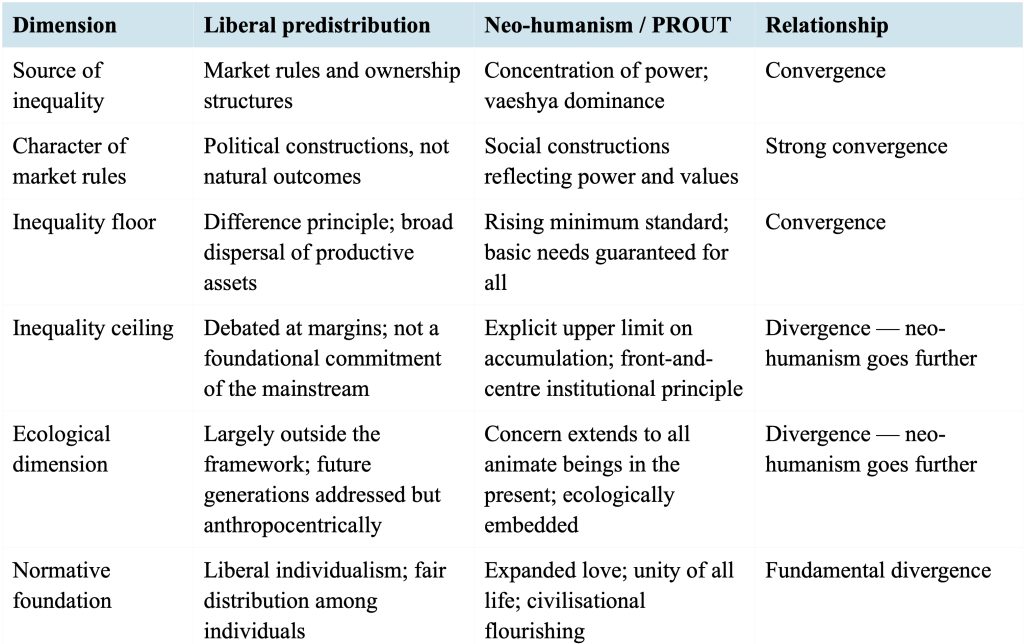
Table 1 summarises the three convergences and the points of departure identified in this section.
Table 1. Liberal Predistribution and Neohumanism: Convergences and Departures
IV. The Ecological Nexus: Where Neohumanism Goes Further
It is here that the predistribution literature encounters its most significant limitation, and where neohumanism, grounded in Sarkar’s insistence on the unity of all life and the expansion of love beyond human boundaries, addresses a dimension that political economy has largely failed to theorise.
The core of Sarkar’s neohumanism is the conviction that love and ethical concern must expand outward: from the narrow self through family and community to all of humanity, and then further to encompass all animate beings and the living systems of the natural world (Sarkar, 1982). This is not sentiment added to a social philosophy; it is the philosophy’s foundation. Human welfare cannot be adequately understood or pursued apart from the ecological and relational fabric in which it is embedded. Social arrangements that systematically exploit and degrade the non-human world do not simply cause environmental damage as a side effect; they express and reinforce precisely the psychology of domination and narrow accumulation that neohumanism identifies as the root of human suffering.
The predistribution literature has not theorised this connection. Its theoretical framework cannot easily generate the insight that ecological degradation and economic concentration are institutionally co-produced: generated by the same mechanisms and requiring integrated rather than parallel responses.
The mechanisms linking concentration to ecological destruction are identifiable and specific. Firms with dominant market positions and regulatory influence can successfully externalize environmental costs (pollution, resource depletion, habitat destruction, carbon emissions) onto the broader public in ways that less powerful actors cannot. The capacity to externalize is itself a form of market power, distributed as unequally as wealth. Capital organised around short-term shareholder returns systematically discourages investment in sustainable production, circular resource use, and long-term ecological stewardship. The temporal horizon of concentrated capital is structurally misaligned with that of living systems. And concentrated ownership of land, extractive resources, and infrastructure creates actors with both the incentive and the political leverage to resist reforms that would internalize ecological costs. Regulatory capture in environmental governance is not a policy failure but a predictable consequence of the same concentration that generates distributional inequality.
Conversely, predistributive reforms that disperse economic power also alter the ecological calculus. Firms operating under stronger democratic accountability and meaningful competitive pressure face weaker incentives to externalize costs and stronger pressure to internalize them. Societies with broader distributions of wealth tend to sustain stronger environmental regulation, partly because the political influence required to weaken such regulation is itself more broadly distributed. Reforming markets for reasons of democratic justice and reforming markets for ecological sustainability are not parallel projects addressing separate problems. They address different expressions of the same underlying concentration of power.
This is precisely the kind of integrated analysis that neohumanism’s philosophical foundation makes possible and that predistribution theory, operating within a liberal-individualist framework, cannot easily reach. Rawls does address obligations to future generations in the later sections of A Theory of Justice and in The Law of Peoples (Rawls, 1999), and this contribution should be acknowledged. However, Rawls’s concern for future generations remains anthropocentric and temporally forward-looking: it concerns what we owe to human beings who will come after us, not the moral standing of the wider community of animate life in the present. Neohumanism’s concern is different in kind, not merely in degree. Sarkar’s expanded circle of ethical concern encompasses all animate beings as participants in a shared moral community now, not merely as future humans to whom we bear obligations. When the normative horizon is confined to the fair distribution of goods among human individuals, whether present or future, the costs imposed upon non-human life and the ecological commons fall outside the frame not because they are unimportant, but because the theory has no internal resources to bring them in.
Sarkar’s expanded circle of ethical concern, rooted not in abstract principle but in cultivating love as a practical spiritual and social capacity, provides exactly those resources. A political economy grounded in neohumanism evaluates economic arrangements not only by their distributional outputs but by whether they support or erode the conditions of life for future generations and the wider community of animate beings. This is a fundamentally different evaluative criterion, not a supplementary one.
V. What Predistribution Theory Cannot Provide
The limitations of the predistribution framework are not merely ecological. They run deeper, into the normative foundation from which the framework operates.
Predistribution theory, in both its political and philosophical variants, is committed to a liberal-individualist understanding of human welfare. Its primary concern is the fair distribution of resources, opportunities, and decision-making power among individuals conceived largely as autonomous agents whose welfare depends on what they possess and what they can do. This generates important analytical insights and concrete policy proposals. But it does not engage with the relational character of human flourishing: what human beings can become is not separable from the quality of the social and ecological relationships within which they develop.
Sarkar’s philosophy begins from a different premise. The unity of all humanity is not an aspiration to be achieved through political reform but a fact to be recognized and expressed through social arrangements. Economic systems that organize human beings in relations of competition, domination, and narrow accumulation do not merely produce unfair distributions; they deform the very psychological and social conditions through which human beings develop their capacities for love, creativity, solidarity, and spiritual growth (Sarkar, 1982). PROUT’s institutional proposals (cooperative enterprise, limits on private accumulation, rational distribution, democratic economic governance) are not primarily efficiency improvements or fairness corrections (Sarkar, 1992). They are expressions of a vision of social life organized around cooperation, mutual recognition, and the development of human beings in their fullness rather than their economic utility.
This civilisational dimension is largely absent from the predistribution literature. It is fair to acknowledge that liberal political philosophy does attend to questions of moral psychology: Rawls, for instance, develops an account of how citizens in a well-ordered society come to develop capacities for mutual respect, a sense of justice, and civic cooperation (Rawls, 1971, sections 71-76). These contributions are real and should be acknowledged. But the moral psychology of liberal theory remains anthropocentric and civic in its orientation: it is concerned with what kinds of citizens democratic institutions require and cultivate. It does not ask what economic arrangements do to the human capacity for love, solidarity, and spiritual development in the broader sense Sarkar intends, and it does not extend its concern for moral development to humanity’s relationship with the wider community of animate life. Political economy can ask whether institutions are more or less fair, more or less efficient, more or less conducive to growth or to democratic stability. It cannot, from within its own framework, ask whether economic life supports or erodes the expansion of love and solidarity beyond the human community to encompass all living beings. Yet for Sarkar, this is not a supplementary question. It is the foundation upon which all other evaluative criteria rest.
This is not a criticism of the predistribution literature for failing to be something other than what it is. Empirical institutional analysis is valuable, and the specificity it provides (identifying precise mechanisms, documenting concrete patterns, proposing testable institutional reforms) is something neohumanist political economy can productively draw upon. The criticism is of treating the liberal-individualist framework as sufficient: as if the fair distribution of goods among human individuals, whether present or future, achieved through reformed market institutions, constitutes the whole of what political economy should seek. From a neohumanist standpoint, this is necessary but profoundly incomplete; it addresses the human share of a problem whose full scope extends to the wider community of animate beings and the ecological conditions upon which all life depends.
VI. A Productive Encounter
The encounter between predistribution scholarship and neohumanist political economy is productive in both directions, and perhaps most fruitful precisely because the two traditions have arrived at overlapping terrain by entirely different routes.
For those working within Sarkar’s tradition, the predistribution literature offers empirical grounding and institutional specificity. The mechanisms through which economic concentration reproduces itself (network effects in digital platforms, financialized short-termism, regulatory capture, the conversion of economic power into political influence) have now been documented in considerable empirical detail. The institutional alternatives (codetermination, cooperative enterprise, anti-monopoly enforcement, broad-based asset ownership) have been theorized and partially tested across various economic contexts. This material is useful. It provides Sarkar’s students with the analytical vocabulary and evidentiary basis to engage political economy debates in terms those debates recognize, without abandoning the normative depth that neohumanism provides.
For the predistribution tradition, and this is a conversation Sarkar’s students are well positioned to initiate, neohumanism offers a normative foundation adequate to the full scale of the crisis. The convergence of ecological breakdown, democratic erosion, and concentrated economic power is not a set of parallel problems requiring coordinated responses. It is a single civilisational condition produced by the organization of economic life around narrow accumulation, competitive domination, and the systematic exclusion of future generations and non-human life from the circle of moral concern. Addressing it requires not only better market rules but a different understanding of what economic institutions are for, one grounded in the recognition of human unity, the expansion of solidarity to all animate life, and the vision of shared flourishing within the limits of the living world.
What Sarkar called neohumanism, the liberation of the intellect from the narrow sentimentality of pseudo-humanism toward a love that encompasses all life, is not a supplement to political economy (Sarkar, 1982). It is the foundation without which political economy, however well-designed its policy proposals, cannot orient itself toward prosperity that is truly common rather than merely aggregate. The predistribution literature has done important work in mapping the institutional terrain. Neohumanism can guide it through to its normative destination.
References
Freeman, S. (2007). Rawls. Routledge.
Gilens, M., & Page, B. I. (2014). Testing theories of American politics: Elites, interest groups, and average citizens. Perspectives on Politics, 12(3), 564–581.
Hall, P. A., & Soskice, D. (Eds.). (2001). Varieties of capitalism: The institutional foundations of comparative advantage. Oxford University Press.
Hacker, J. S. (2011). The institutional foundations of middle-class democracy. Policy Network.
Hacker, J. S., & Pierson, P. (2010). Winner-take-all politics. Simon & Schuster.
Inayatullah, S. (1999). Understanding Sarkar: The Indian episteme, macrohistory and transformative knowledge. Brill.
Khan, L. M. (2017). Amazon’s antitrust paradox. Yale Law Journal, 126(3), 710–805.
Lazonick, W. (2014). Profits without prosperity. Harvard Business Review, 92(9), 46–55.
Malleson, T. (2014). After occupy: Economic democracy for the 21st century. Oxford University Press.
Meade, J. E. (1964). Efficiency, equality and the ownership of property. Allen and Unwin.
Philippon, T. (2019). The great reversal: How America gave up on free markets. Harvard University Press.
Rawls, J. (1971). A theory of justice. Harvard University Press.
Rawls, J. (1999). The law of peoples. Harvard University Press.
Robeyns, I. (2019). What, if anything, is wrong with extreme wealth? Journal of Human Development and Capabilities, 20(3), 251–266.
Robeyns, I. (2024). Limitarianism: The case against extreme wealth. Allen Lane.
Sarkar, P. R. (1982). The liberation of intellect: Neohumanism. Ananda Marga Publications.
Sarkar, P. R. (1992). Prout in a nutshell. Ananda Marga Publications.
Winters, J. A. (2011). Oligarchy. Cambridge University Press.
Wu, T. (2018). The curse of bigness: Antitrust in the new gilded age. Columbia Global Reports.