
Sohail Inayatullah, Rachael Smith and Eva Oloumi. Photo by Martin Sanchez
Abstract
This paper presents the dialectical method as a robust framework for scenario development within futures studies. It begins by situating this approach within a broader typology of existing scenario methodologies, including those based on critical uncertainties, archetypes, and organizational logic. The core of the paper explicates the philosophical foundations of dialectics—drawing from Hegelian, Materialist, Tantric, and Taoist traditions as synthesized by Johan Galtung—which posits reality as a holistic tension of opposites. This theoretical foundation is then operationalized through three distinct applications. The first explores civilizational futures by examining the contradiction between the Western imperative for expansion and planetary ecological limits, yielding four scenarios: The Techno-Utopian Escape, The Fortress World, The Long Emergency, and The Gaian Partnership. The second application applies the approach to institutional transformations. Three scenarios are offered: The Citadel, The Colony, The Labyrinth and The Garden. The third application maps the method onto the internal world of the self, analyzing the tension between an executive’s “Pusher” identity and their “disowned” needs for rest and connection, resulting in the scenarios of The Glorious Burnout, The Forced Retreat, The High-Wire Act, and The Integrated Warrior. The paper closes by arguing that the dialectical method, historically limited by human capacity, can now be scaled through computational approaches. This is linked to broader issues of macrohistory and futures. In conclusion, the dialectical method offers a powerful tool for generating transformative scenarios by directly engaging with the underlying contradictions that shape both external and internal realities.
Keywords: Dialectics, Futures Studies, Scenarios, Causal Layered Analysis

Tectonic convergence as metaphor for contradiction and transformation. Concept and prompt by Eva Oloumi; generated using OpenAI image generation tools, 2026.
1. A Typology of Scenario Methodologies
Scenario planning has evolved a range of methodologies, each offering a distinct lens for exploring alternative futures. A conventional approach, famously employed by Royal Dutch Shell, utilizes a 2×2 matrix derived from two critical uncertainties, which are themselves based on the directionality of key drivers of change (Wack, 1985). This method generates four distinct quadrants, or scenarios.
A second major approach is archetypal, most prominently articulated in the Manoa School method developed by Jim Dator (2009). Based on empirical analysis of recurring images of the future, this framework posits four primary archetypes: Continued Growth, Collapse, Discipline, and Transformation. A variation tailored for organizational context also uses four scenarios: Business as Usual (an analogue for Growth), Collapse, Outlier (a disruptive alternative), and Transformation.More recently, the Change
Progression Scenario Method, developed by Inayatullah, and Milojević, derives four archetypes from the Futures Triangle framework: No Change (the weight of history dominates), Marginal Change (minor adjustments), Adaptive Change (systemic reform), and Radical Change (paradigm transformation) (Inayatullah, 2015). Another approach, the Integrated method, involves a process of first identifying the preferred future, then excavating the disowned, or hidden future, subsequently creating an integrated scenario, and finally ensuring variation is accounted for through an outlier (Inayatullah, 2004).
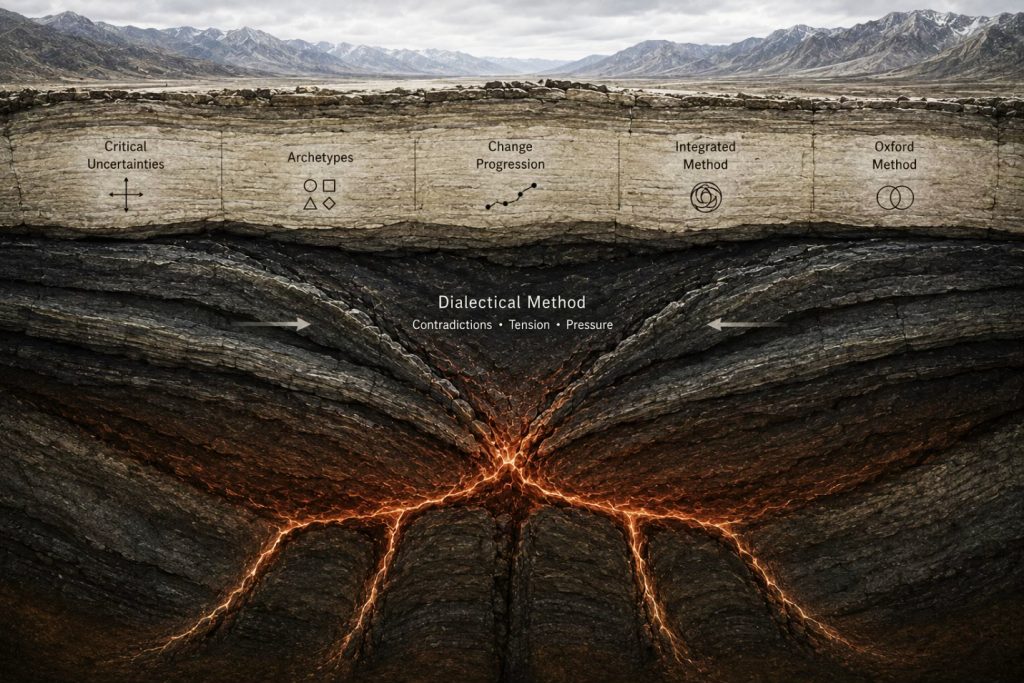
Geological strata as metaphor for layered foresight methodologies and subsurface contradiction. This visualizes the dialectical process itself – where opposing forces build tension until a new landscape is formed. Concept and prompt by Eva Oloumi; generated using OpenAI image generation tools, 2026
Both the Shell method as well as the very recent Oxford scenario approach (Ramirez & Wilkinson, 2016) derive their scenarios from external drivers. The scenarios emerge from current uncertainties; will x or y occur and to what extent (high or low). Not only are core contradictions not explored, since they do not operate from a dialectical view of the world, and thus critics argue that even as they claim to present alternatives do so in the context of strategic power. For example, while Shell and its foresight approach has been successful from a view of profit, their inability to ask the question of who is not in the room led to environmental disasters and continued human rights abuses (Amnesty International, 2025). In contrast to the 2×2 approach, the dialectical method assumes contradictions will create challenges to the accepted linearity. The real, as it is, exists within opposites. Understanding these opposites can help us understand emerging futures.
The dialectical approach to futures was developed in the 1960s by Johan Galtung (1996). It draws from deep Indic and Sinic philosophical traditions to analyze reality through its constitutive contradictions. For Galtung, the core contradictions are centre versus periphery.
2. The Philosophical and Pragmatic Foundations of Dialectics
The dialectical method assumes that change is not only natural but arises from the interactive and holistic tension of opposites. It posits that reality is fundamentally constituted by contradictions. While there are different dialectical traditions – explored below – they all share a core idea: that reality is shaped by the tension of opposites and that change comes from this dynamic.
This has several intellectual lineages. In the Hegelian tradition, it manifests as a dialectic of ideas, wherein a thesis (s) inevitably generates its antithesis (-s), leading to a synthesis that negates the negation (–s) and forms a new state (Hegel, 1807/1977). For historical materialists, these contradictions are in material social systems, with each historical stage containing the socio-economic seeds of its own supersession (Marx and Engels, 1846/1978). The universe in this perspective is in a constant process of change in accordance with the three laws of dialectics: law of unity and strife of opposites, law of transformation from quantity and quality, and the law of the negation of the negation (McCarthy, 1972).
This structure is congruous with, though distinct from, the concept of opposites in Tantra, and later in Taoism. Tantric philosophy posits a perpetual interplay between vidya (introversial, subjective, oriented toward collective good) and avidya (extroversial, malevolent, oriented toward the narrow ego). This cosmic struggle is seen as endless, ensuring the material world is in a constant state of flux. For the Tantric philosopher P.R. Sarkar (1967), this translates into a theory of social cycles, where the dominance of class archetypes—Workers (Shudras), Warriors (Kshatriyas), Intellectuals (Vipras), and Capitalists (Vaishyas)—revolves in an evolutionary, cyclical pattern. This evolution is not merely cyclical but pulsative; social movements exhibit periods of intense effort and change followed by pauses for rest and consolidation, akin to the rhythm of breath. While the cycle is endless, there are pathways out for a better society, including sadvipras or spiritual leadership not affiliated with any class or identity and thus able to change the cycle to the spiral. However, the dialectic can never end in the material and mental world, only in the spiritual where there are contradictions is peace or shanti possible.
The Taoist notion of yin-yang offers a complementary perspective, emphasizing that no system is pure; light contains the seed of darkness, and vice versa (Lao Tzu, c. 4th century BCE/1997). It is a philosophy of dynamic balance and the inherent presence of opposites within any whole. For futures studies, Galtung (1971, 1996) applies this dialectical lens to social phenomena, arguing that to understand the future, one must analyze the tensions, and opposites inherent within any given system. For him, the key tension is between the centre and the periphery. The asymmetry of power is used to create alternative futures.The
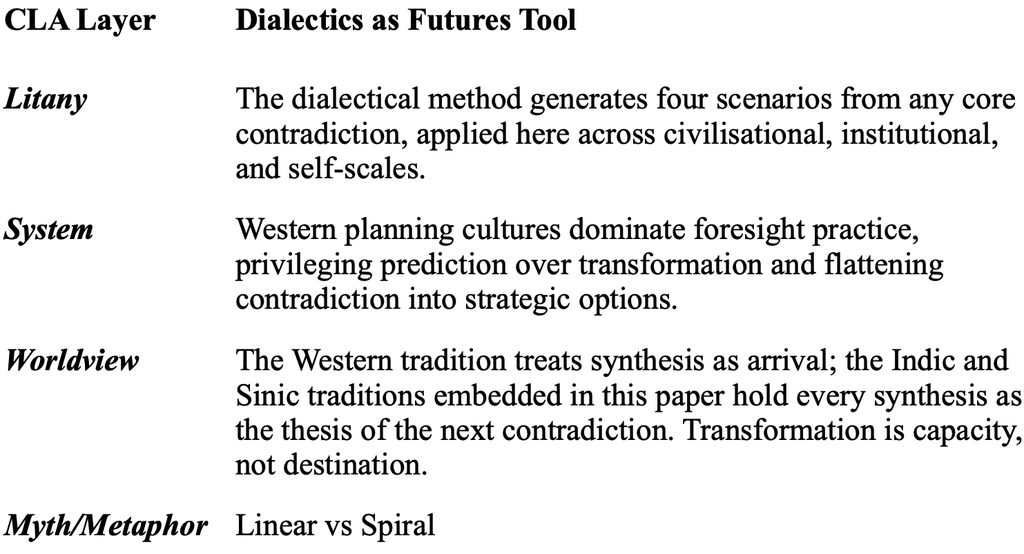
Western and Indic-Sinic traditions offer different maps of transformation. In both the Hegelian and Marxist traditions, the dialectical movement carries an implicit teleology: synthesis is an endpoint, a resolution that closes the contradiction. For Hegel, history moves toward the self-realisation of Absolute Spirit; for Marx, toward the classless society. Transformation, in this view, is arrival.
The Tantric and Taoist traditions differ fundamentally. The yin-yang does not resolve into stable synthesis; it holds opposites in perpetual tension. For Sarkar, social cycles spiral rather than terminate, and if each dominant archetype contains the seeds of its own supersession, then every synthesis is already the thesis of the next contradiction. For those using the dialectical method in practice, the distinction is not exclusively philosophical. The dialectical traditions surveyed above are themselves in tension on what to do with contradiction; resolve it, in the Hegelian and Marxist line, or hold it in perpetual tension, in the Tantric and Taoist one.
The first table uses Inayatullah’s Causal Layered Analysis (1998, 2004, 2015) to map the tensions between Western and Tantra/Taoist.
Table 1. Causal Layered Analysis of the Dialectical Method as Futures Tool
3. Application I: Civilizational Contradiction and Planetary Futures
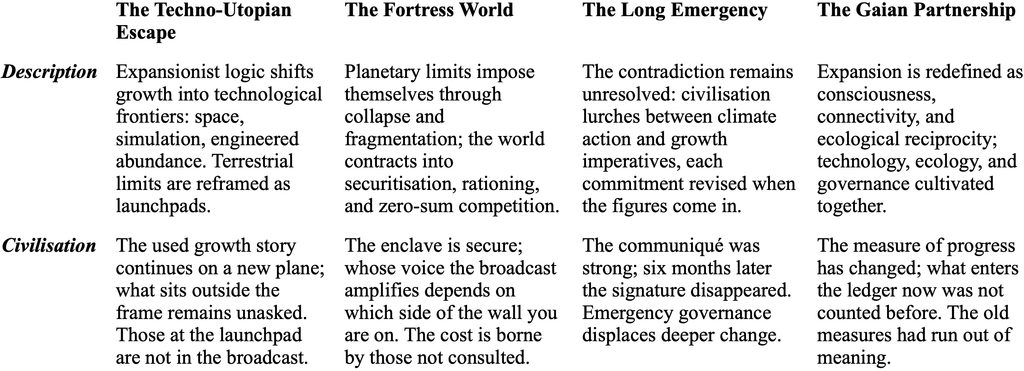
To apply dialectics to scenarios, we consider the dialectical tension between the Western civilizational impulse for relentless expansion, and the biophysical limits of a finite planet. This core contradiction generates four potential scenarios. The scenarios developed are done so as competing narratives that operate at the deeper levels of CLA: worldviews and myths/metaphors.
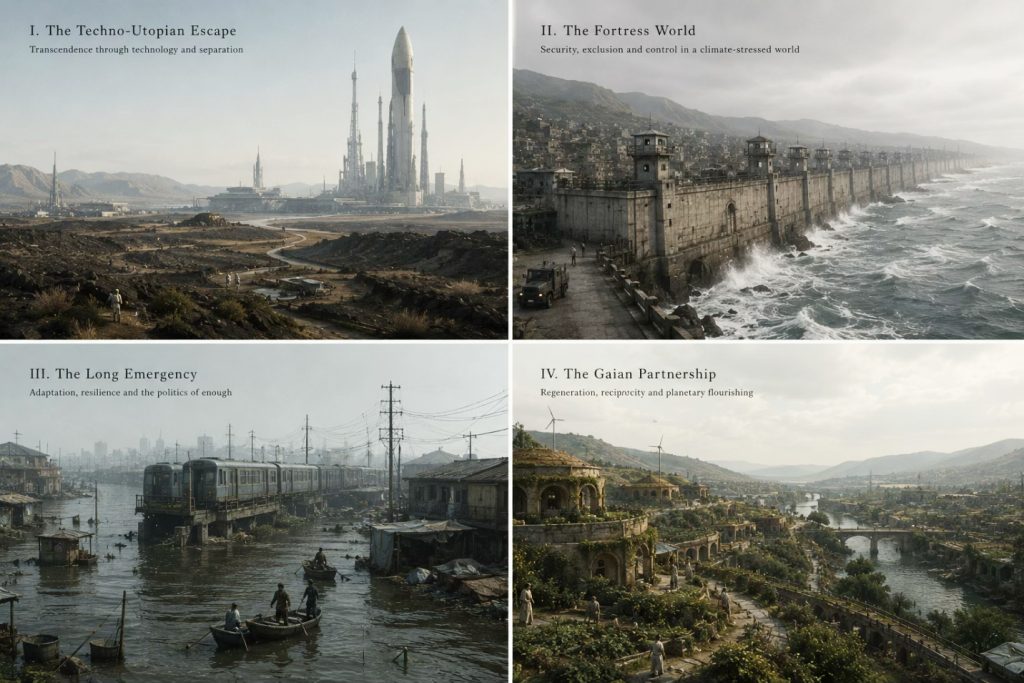
Civilizational Contradiction and Planetary Futures. Concept and prompt by Eva Oloumi; generated using OpenAI image generation tools, 2026
Scenario 1: The Techno-Utopian Escape. In this scenario, the expansionist logic prevails by transcending its terrestrial limitations. Acknowledging Earth’s physical constraints, this future redirects the impulse for growth toward technological frontiers: space colonization, the creation of immersive digital metaverses, and the bioengineering of life itself. The Earth is reframed as a launchpad for non-terrestrial expansion. The dominant metaphor remains that of the frontier and Manifest Destiny, continuing a linear narrative of progress on a new, technological plane.
Scenario 2: The Fortress World. This scenario represents the ascendancy of the opposing force, where the planet’s limits impose themselves with catastrophic consequences, leading to systemic collapse. The expansionist project implodes into a defensive, zero-sum struggle over dwindling resources. This future is characterized by aggressive nationalism, militarized borders, and resource wars—a form of eco-apartheid where affluent enclaves attempt to insulate themselves from climate chaos, and mass migration. The global system fragments, and the guiding metaphor shifts from the open frontier to the walled fortress.
Scenario 3: The Long Emergency. Here, the contradiction remains unresolved, resulting in an unstable, oscillating state. This future is defined by a reactive lurching from one crisis to the next, with periods of performative climate action being abandoned during economic recessions when the growth imperative reasserts itself. It is a world governed by short-term fixes and perpetual anxiety, where the core tension is poorly managed rather than resolved. As Galtung (1996) posits, the crises are not external to the system but are, in fact, constitutive of it; the Western paradigm, in this view, is defined by its perpetual need for crisis.
Scenario 4: The Gaian Partnership. The fourth scenario envisions a transcendence of the contradiction itself. The definition of “expansion” is transformed from material accumulation to the development of consciousness, well-being, connectivity, and knowledge. The dominant worldview shifts from anthropocentric dominion to a partnership with a living planetary system (Gaia). The economic model moves from extractive to regenerative, and governance evolves beyond the nation-state toward planetary management of shared resources. This represents the spiral evolution described by Sarkar (1987), acknowledging inherent limits but transcending them through a new ethical and spiritual synthesis. However, the dialectics does not end, as new contradictions will emerge, for example, between the planetary and the local, spaceship earth and the bio earth. Every system creates seeds of its own destruction.
Table 2: Application I — Civilizational Contradiction and Planetary Futures
4. Application II: The Dialectics of Institutional Transformation
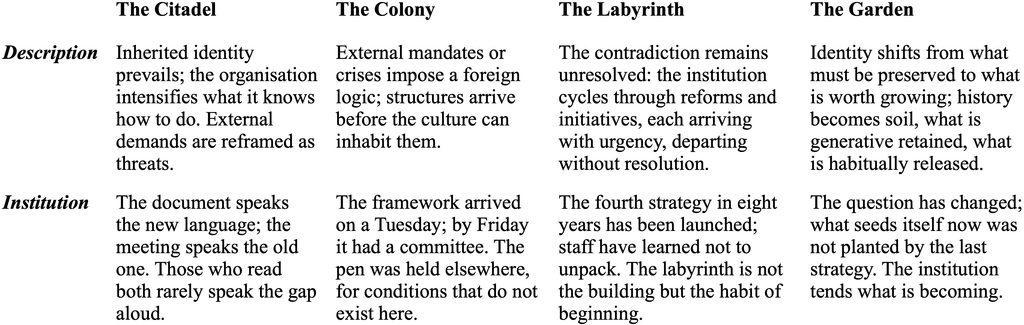
The dialectical method applies equally at the institutional level, the meso scale between civilisational systems and the individual self, and the terrain on which most futures work is conducted. Organisations of all kinds, public services, schools, hospitals, universities and NGOs, carry within them a core contradiction between the inherited identity that gives them coherence and the emergent demands of a world they were not designed to serve. Each pole has its own logic. An institution that abandons its history loses the coherence collective action requires. One that clings to it becomes a used future (Inayatullah, 2015), still enacting the answers to questions no longer being asked. This core contradiction generates four scenarios.
Scenario 1: The Citadel. In this scenario, the logic of inherited identity prevails. The institution intensifies what it already does, redirecting the impulse for continuity toward new frontiers of the familiar: the technology invented internally and shelved, the reform commissioned and filed, the net zero commitment published while the portfolio remains unchanged. The institution becomes a monument to its own continuity. There is no sunset clause.
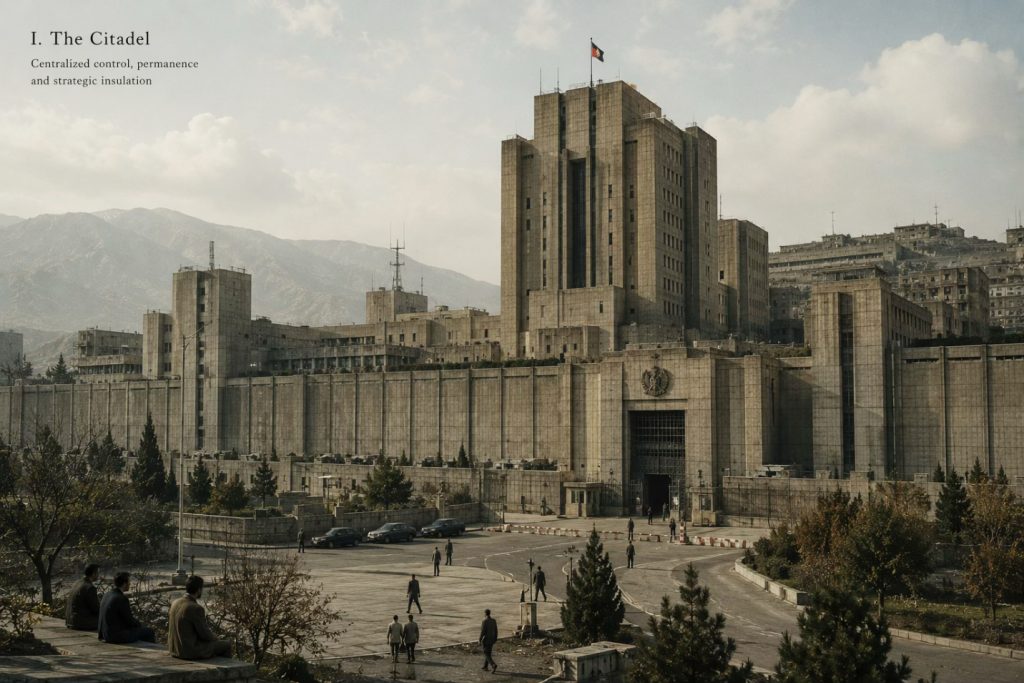
“The Citadel”. Concept and prompt by Eva Oloumi; generated using OpenAI image generation tools, 2026
Scenario 2: The Colony. This scenario represents the ascendancy of the opposing force, where the limits of institutional autonomy impose themselves with destabilising consequence, leading to displacement. A mandate arrives, a framework is imposed, a crisis forces restructuring. Structures arrive fully formed, authored elsewhere, for conditions that do not exist here, and governance takes root before the culture is ready to inhabit it. Leadership changes; worldview does not. The guiding metaphor shifts from home to occupied territory, governed by external logic. In the colon, pendulum shifts are likely, with swings from centralization to decentralization, following the mandate and challenging the mandate.
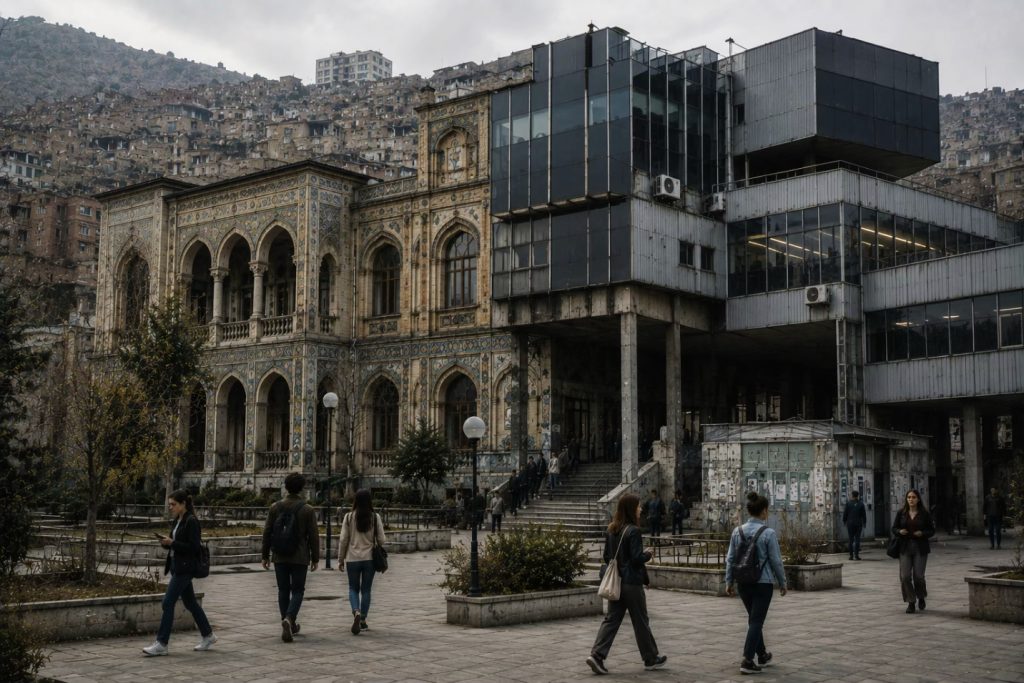
“The Colony”. Concept and prompt by Eva Oloumi; generated using OpenAI image generation tools, 2026
Scenario 3: The Labyrinth. Here the contradiction remains unresolved, resulting in a state of perpetual oscillation. This future is defined by the reactive cycling from one initiative to the next, with curricula reformed and reformed again, health services reorganised across decades, sustainability commitments abandoned when the pressure to perform reasserts itself. Each new strategy arrives with urgency and departs without resolution, leaving behind not cynicism born of malice but of accumulated experience that change announced is rarely change embedded. It is an organisation in which motion has replaced direction, the core tension managed, contained, never addressed. The labyrinth, in this view, is defined by its perpetual need for new beginnings. In the day to day, this is evidenced by endless meetings, circling back, discussions about discussions, and the core inability to understand deep structures and narratives. For example, in the university between the castle (feudal structure of the professoriate) and the bank (funding).

“The Labyrinth”. Concept and prompt by Eva Oloumi; generated using OpenAI image generation tools, 2026
Scenario 4: The Garden. The fourth scenario envisions a transcendence of the contradiction itself. The definition of institutional identity is transformed from what must be preserved to what is worth growing. The dominant logic shifts from protecting what exists to cultivating what is becoming. Industrial knowledge becomes the ground for regenerative production, the extractive logic superseded. The founding values of a profession, buried under administrative accumulation, are recovered and made the architecture of new practice. A cooperative rooted in cultural identity grows into a globally significant enterprise, its founding values the engine of that growth. An indigenous philosophy of relationship, long marginalised, becomes the foundation of public policy. History becomes generative. The metaphor shift from monument to garden represents the spiral evolution described by Sarkar (1987), each synthesis opening toward the next horizon. The garden is often viewed as an end state, however, the tension between weeds and other plants will not disappear, nor the ability of one species to dominate others.

“The Garden”. Concept and prompt by Eva Oloumi; generated using OpenAI image generation tools, 2026
Table 3: Application II — The Dialectics of Institutional Transformation
5. Application III: The Dialectics of the Self
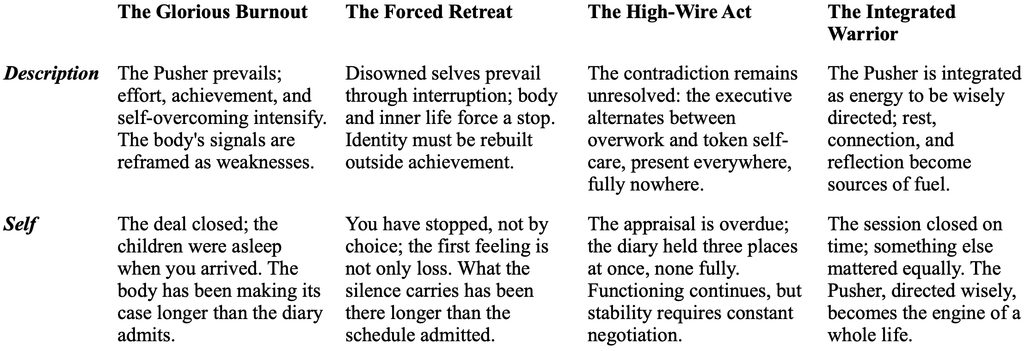
The dialectical method can be similarly applied to the internal world, to our life choices. Utilizing both Galtung’s framework and the “Voice Dialogue” theory of Hal and Sidra Stone (1989), we can analyze the contradiction within a high-achieving executive between the dominant “Pusher” self and the disowned selves requiring rest, connection, and play. This issue is a dominant narrative in foresight workshops. Participants may imagine different scenarios for their nations and organizations, but institutions are more than just rules and ideas that govern, they are humans who exist in these settings. As the external world changes, individuals are confronted with a crisis of meaning, of purpose. This often plays itself out in the following scenarios.
Scenario 1: The Glorious Burnout. This outcome sees the ascendancy of the Pusher identity. The executive intensifies their efforts, viewing the body’s needs as weaknesses to be overcome. While this may yield short-term professional success, the trajectory leads to an inevitable collapse, manifesting as a major health crisis, or the disintegration of primary relationships. The Pusher self-achieves a Pyrrhic victory.
Scenario 2: The Forced Retreat. In this scenario, the disowned selves prevail through rebellion. The body forces a cessation of activity through debilitating injury, illness, or a profound emotional breakdown. The executive is unplugged from their professional life, leading initially to anger and resentment. However, this forced pause creates the conditions for a potential re-evaluation, and a slow, difficult journey toward reintegrating the neglected aspects of the self.
Scenario 3: The High-Wire Act. This represents the future of the unresolved contradiction, a state of perpetual brinkmanship. The executive alternates between periods of intense work and tokenistic gestures of self-care, never being fully present in any domain. It is a state of sustained, low-grade desperation, where neither the Pusher nor the disowned selves achieve satisfaction, and both work and life lose their vitality.
Scenario 4: The Integrated Warrior. This scenario transcends the inner conflict. Through a process of making the unconscious conscious, the executive reframes the Pusher not as an antagonist but as a source of energy to be wisely directed. Rest and connection are understood not as drains but as essential sources of fuel. “Winning” is redefined to include protecting time for reflection, being present with family, and listening to the body. The Pusher self is transformed from a tyrant into a powerful ally in the service of a whole and integrated life. By making these inner scenarios conscious, the individual gains the agency to choose a transformative path (Stone and Stone, 1989).
Table 4: Application III — The Dialectics of the Self
6. Dialectics and Computational Scaling

Dialectics and Computational Scaling. Concept and prompt by Eva Oloumi; generated using OpenAI image generation tools, 2026
The dialectical method can also be turned directly toward the practice and infrastructure of futures and policy work itself. The contradiction at this scale is between synthesis and pluralism: futures practitioners, policymakers and institutions are incentivized to produce coherent, actionable analysis on the one hand, while epistemic integrity requires the preservation of divergent narratives on the other. Synthesis enables decisions to take shape, but at scale it defaults to the mean or operates in service of existing power structures. Pluralism preserves integrity of data and representation from systems but is overwhelming as noise unless there is a method to manage the scale of contradiction.
For sure, dialectics is the most demanding of the practitioner. Holding contradiction as generative rather than as something to be ignored, clustered or compartmentalized requires not only sustained reading, comparison, and judgement that has historically been limited by what one practitioner can hold in their mind but also by their ability to resist the urge toward resolution and hold competing positions without collapsing toward one’s own bias. Holding contradiction as generative requires what Keats called negative capability; the capacity to remain in uncertainty without reaching for resolution. This works against cognitive dissonance, the affective pull to reduce the discomfort of holding contradictory positions by collapsing one of them. The practitioner who cannot resist that pull will, consciously or not, reach for synthesis before the analysis is done. The applications above are conducted in this way: a bounded set of texts, conversations, or observations, worked through by a human reader. The civilizational, individual, and institutional scales remain tractable through this kind of practice.
The scale on which the mean-and-power problem identified becomes acutely important differs. Hundreds of government units, think tanks, foresight units, multilateral bodies, and academic centres produce continuous output across languages and time, each with a narrative understanding of the world today and the futures that may come. The contradictions that shape collective foresight are distributed across this corpus, which no individual reads in full and the real shape of divergence is assumed rather than confirmed.
Recent developments in computational social science may change the terms of this problem. Topic modelling and deep narrative analysis (Debnath et al., 2020) provide systematic ways to extract multilingual narrative structures from large bodies of unstructured policy text, addressing the limitations of manual analysis around scale, repeatability, and directional bias. Computational approaches to narrative theory (Piper, So and Bamman, 2021) offer frameworks for representing narratives in ways that can be queried, compared, and held in tension rather than reduced to a single account. Interactive narrative analytics combine computational analysis with human interpretation augmenting sensemaking processes that would otherwise be near impossible for volume at scale. Together these developments make it possible, for the first time, to operationalise the dialectical method at the scale at which collective foresight is produced.
The dialectical commitment shapes how these methods are used. The same computational techniques can serve opposite epistemic ends. A platform built on synthesis logic uses NLP to compress, extract the dominant narrative, summarise the consensus, deliver the answer. This is the route to the mean and to power, executed at machine speed. A platform built on dialectical logic uses the same techniques to expand, surface the points of convergence and divergence, identify the high-tension narrative pairs, and generate the four-scenario structure as an analytic output. The contradictions that synthesis erases are made visible and held open. The difference is not in the technology but in the epistemic posture the technology serves.
This move has a precedent at the organisational level in Mason and Mitroff’s (1981) Strategic Assumption Surfacing and Testing. SAST treats ill-structured strategic problems as resolvable not through better analysis of given assumptions but through the explicit surfacing of opposing assumptions and their dialectical examination (Mitroff & Emshoff, 1979). The method is intentionally adversarial; its discipline lies in refusing the premature integration of incompatible worldviews. Computational scaling of dialectical foresight inherits this logic. The system’s task is not to tell the decision-maker what to think but to surface what is in tension and make the underlying assumptions of competing narratives examinable. Causal layered analysis becomes a scaffolding to ensure the opposites are held are integrated whether in the garden of organizations or selves. However, methods too have contradictions. While SAST and CLA force the practitioner to understand the contradictions in the room, both require not just attention in the moment, but a meta-cognition that whether Hegelian, Marxian, Sarkarian, or other forms of dialectics, what is, will always become its dialectical opposite. That is, merely having computational power does not resolve the dialectics – it accelerates it. The dialectical commitment requires that this argument apply to itself. Computational scaling of dialectical foresight is not an arrival but a thesis whose antithesis is already forming. The infrastructure that surfaces contradictions has its own contradictions: the corpus it analyses excludes what institutions do not produce; the models it uses carry the biases of their training; the visualizations and outputs themselves are maps with distortions and force some levels of synthesis due to the inherent tensions between human usability and requisite granularity; the choice of which fault lines count as signal is itself an act of synthesis.
Moving back to the philosophical, avidya, in Sarkar’s framing, finds new forms in every new structure. For Hegel and Marz as well as Galtung, the dialectic continues as power will always be asymmetrical. At the level of the individual, only spiritual enlightenment resolves dialectics. At the societal level, it cannot be resolved. However, it can be managed. Through meta-cognition and leadership, the cycle can be made into a spiral, there is progress and the cycles of opposites continue (Inayatullah, 2002, 2017). The Tantric tradition holds that this is not a flaw to be engineered out but the condition of any system in time. Each synthesis is the thesis of the next contradiction. The vision of the future is what keeps the spiral moving, not the elimination of the opposites that make a spiral possible. Computational dialectics, however, can possibly extend the method’s reach; it does not close the dialectic. It cannot. Nothing does.
6. Conclusion
The dialectical method provides a unique and powerful tool for futures analysis. By assuming that contradiction is a fundamental and generative force, it allows for the development of scenarios that move beyond simple extrapolation, or the management of uncertainties. It can be applied with equal rigor to macro-level civilizational challenges and micro-level intra-personal conflicts. Computational approaches now make it possible to extend the dialectical method to collective foresight at the planetary scale without collapsing, surfacing the fault lines rather than averaging divergence into the mean or surrendering it to power Its primary contribution is its ability to not only diagnose the tensions that define the present but also to illuminate pathways toward their potential transcendence, thereby creating futures that are genuinely transformative.
Dialectics as method brings the following benefits to futures thinking. First, there is no end state or perfect scenario. The process must be iterative. Second, non- or post-western worldviews allow for a diversity of temporal frameworks. Third, moving from scenarios to policymaking and planetary visions, dialectics offers a worldview where there is no end state, no utopia that ends cognition and meta-cognition.
The ultimate value of the dialectical method isn’t just in creating better scenarios, but in building our collective capacity to hold creative tension and navigate complexity without seeking premature or false resolutions.
References
Amnesty International (4 September 2025). “Nigeria: Shell remains responsible for cleaning up and remediating historical oil production.” https://www.amnesty.org/en/latest/news/2025/09/nigeria-shell-remains-responsible-for-cleaning-up-and-remediating-historic-oil-pollution-despite-divestment/
Dator, J. (2009). Alternative futures at the Manoa School. Journal of Futures Studies, 14(2), 1–18.
Debnath, R., Darby, S., Bardhan, R., Mohaddes, K., & Sunikka-Blank, M. (2020). Grounded reality meets machine learning: A deep-narrative analysis framework for energy policy research. Energy Research & Social Science, 69, 101704.
Festinger, L. (1957). A theory of cognitive dissonance. Stanford University Press.
Galtung, J. (1971). A structural theory of imperialism. Journal of Peace Research, 8(2), 81–117
Galtung, J. (1996). Peace by peaceful means: Peace and conflict, development, and civilization. SAGE Publications.
Hegel, G. W. F. (1977). Phenomenology of spirit (A. V. Miller, Trans.). Oxford University Press. (Original work published 1807)
Inayatullah, S. (1998). Causal layered analysis: Poststructuralism as method. Futures, 30(8), 815–829
Inayatullah, S. (2002). Understanding Sarkar: The Indian episteme, macrohistory and transformative knowledge. Brill
Inayatullah, S. (2004). The causal layered analysis (CLA) reader: Theory and case studies of an integrative and transformative methodology. Tamkang University Press.
Inayatullah, S. (2015). What works: Case studies in the practice of foresight. Tamkang University Press.
Inayatullah, S. (2017). Prout in power: Policy solutions that reframe our futures. Proutist Bloc India Publications
Keats, J. (1958). Letter to George and Thomas Keats, 21–27 December 1817. In H. E. Rollins (Ed.), The letters of John Keats, 1814–1821 (Vol. 1, pp. 191–194). Harvard University Press. (Original work written 1817)
Lao Tzu. (1997). Tao Te Ching (S. Mitchell, Trans.). Harper Perennial Modern Classics. (Original work c. 4th century BCE)
Marx, K., & Engels, F. (1978). The German ideology. In R. C. Tucker (Ed.), The Marx-Engels reader (2nd ed., pp. 146–200). W. W. Norton and Company. (Original work published 1846)
Mason, R. O., & Mitroff, I. I. (1981). Challenging strategic planning assumptions: Theory, cases, and techniques. Wiley.
McCarthy, H. (1972). An Outline of Philosophy. Unpublished. University of Hawaii.
Mitroff, I. I., & Emshoff, J. R. (1979). On strategic assumption-making: A dialectical approach to policy and planning. Academy of Management Review, 4(1), 1–12.
Piper, A., So, R. J., & Bamman, D. (2021). Narrative theory for computational narrative understanding. In Proceedings of the 2021 Conference on Empirical Methods in Natural Language Processing (pp. 298–311). Association for Computational Linguistics.
Ramírez, R., & Wilkinson, A. (2016). Strategic reframing: The Oxford scenario planning approach. Oxford University Press.
Sarkar, P. R. (1967). Human society, Part 2. Ananda Marga Publications.
Sarkar, P. R. (1987). A few problems solved, Part 7. Ananda Marga Publications.
Stone, H., & Stone, S. (1989). Embracing our selves: The voice dialogue manual. New World Library.
Wack, P. (1985). Scenarios: Uncharted waters ahead. Harvard Business Review, 63(5), 73–89.
wonderful article