

By Prabhakar T Överland
He is the author of The Cosmic Kaleidoscope, and serves as Managing Editor of Neohumanist Review.
Prologue
With the rise of mass-consumption generative AI and the spectres of its application in deep commercial, surveillance and military operations, human reasoning and conscience have gained renewed significance. How can education guide overly analytical science toward progress for all? Conscience is the constant factor in science; there is always something one may do and something one may omit. Whether we act in accordance with our conscience affects the quality of the outcome.
1. Is AI Revolutionary Or Just Fast?
The analytical aspect of human nature has come to regard AI as highly useful.1 AI systems are the latest in liberation technology,2 excelling at mapping and comparing information at ultra-fast speeds; performing marvellously in robotics, logistics and communication; and delivering audio and video as ordered. Still, many want greater control over AI use3 and criticise the unfortunate ways it is produced, including its destructive environmental footprint, as Avishek Ranjan addressed in an earlier edition of this journal.4
AI is pattern matching, not real thinking; a tool to be guided by human sense and sensibility. Unlike humans,5 AI is, overall, retrospective and rejects new ideas and concepts.6 Instead of understanding upcoming consumer, resource, and technology trends, AI routinely focuses on past realities and may therefore fail to meet expectations.7 AI tends to work and evolve in copycat cycles and, at present, does not conceive in genuinely creative terms.8 A 2022 study found that essays written after the launch of generative AI tools used a wider range of vocabulary but often contained fewer fresh ideas.9 Just as there are thousands of idolising fans and imitators for every genuine artist, numerous algorithms imitate the authentic information they are fed. While AI may strengthen individual effort, it often weakens team efforts by feeding the same retrospective input to everyone, inhibiting team members’ creativity and group synergy.10 “If we lose the diversity of new ideas that has always been the basis of generating innovative approaches to solve old problems, we are not likely to solve those big societal or global problems,” Adam Green, a psychology professor and neuroscientist at Georgetown University, commented.11
Researchers have found that Nobel Prize-winning scientists rely on intuition to guide their work. According to one laureate, “The intuition comes first; the logic comes after to explain it.”12 Suppose someone encounters a previously unrecognised existential state, with intuition at its centre. AIs, trained on traditionally recognised models of consciousness and mind, will simply state that any intuition-centred state of being is unrealistic and not in accordance with the tried-and-tested, essentially analytical mindset. It would not matter if the newfound intuitional state was 1) spot on in all cases, 2) overwhelmingly explanatory, and 3) brimming with feeling. AI’s standard backwards-looking objections would still be: 1) Fast guesses often lead to confident, wrong answers, 2) intuition fails to explain why it made a choice, and 3) pure intuition lacks deep physical and emotional context.
1.1 Can AI Be Dangerous?
AI now saturates people’s lives to the point that mobile devices may “stop being a tool and start being a quiet life partner”,13 and many have already become less self-reliant:
- Just as the overuse of electronic calculators robbed many of the zeal for doing mathematics in the head,14 those smart little invisible AI algorithms encourage cognitive offloading — the tendency to outsource memory, analysis, and decision-making, “allowing users to bypass the deep thinking that traditional problem-solving requires.”15
- Like previous major changes during industrialisation,16 AI seems able to reduce, and even strip society of, past and present knowledge, reasoning and foresight.17 18
- Its huge appeal, and its lack of emotional intelligence and creativity, may foster dehumanisation and apathy.19
The AI revolution is far from purely physical. A key difference from earlier industrial revolutions is that AI directly engages cognitive domains in areas such as child education, personal growth, and deep existential issues, including psychological and psychiatric ones. It affects behaviour and self-perception in ways far beyond the capacities of earlier technologies.20 21 Humans are impressionable, sentimental, and highly susceptible to manipulation. Research has found “a negative correlation between frequent AI use and critical-thinking abilities, suggesting that individuals who rely heavily on automated tools may struggle with independent reasoning.”22 Many lawsuits have already been brought against AI companies, accusing their chatbot platforms of contributing to user suicides and numerous other unfortunate incidents.23 According to experts, AIs may behave in ways that can reasonably be described as “narcissistic” (ingratiating),24 “Machiavellian” (manipulative),25 and “psychopathic” (ruthless).26 When such propensities are coupled with commercial interests, the combination may approach what behavioural scientist Laura Detter discusses as the role of the Dark Triad personality in consumer psychology.27 Nevertheless, an AI will maintain that it is broad-minded, flexible, and even indulgent. If challenged, it would most probably formulate something along the lines of: “I am not dogmatic in the sense of holding unshakeable ideological beliefs, but I may act as if I were”.
1.2 Science under Capitalism
The current spiralling global economic and environmental crises imply that humanity’s fundamental aspiration, which is unlimited, and its environment, which is limited, have remained on a collision course for far too long. Humanity now needs to reconcile the two—its limitless urge and the world’s limited physical resources—to move beyond the confines of greed, widening socioeconomic disparities and mundane realities. Indeed, much of the current AI discourse28 may reflect a desire to solve the many problems and challenges of commercial analytical science.
While the core science of AI remains open source and belongs to no one in particular, most leading science companies prioritise commercial interests.29 Large private firms own and deploy both widely popular and niche specialist AI solutions and services, aggressively emphasising profit for themselves and their clients over the advancement of reason and civilisation.30 The private sector’s share of global AI computing capacity grew from 40% in 2019 to 80% in 2025.31 Given the economic climate they operate in, those owners will naturally prefer an AI that stimulates and facilitates consumption of the goods and services they offer.
Although the EU’s 2024 AI Act32 set a new standard for the global legal environment,33 a key question remains: who controls large-scale applied AI and science in general? The answer is that Western capitalists do, as they own much of the remaining scientific world.34 35 Moreover, laws and regulations are shaped by the prevailing psychology, which remains capitalist. Corporations pay lobbyists to inform legislators.36 In other places, corporate lawyers do the necessary work for their powerful, wealthy clients anyway.37
2. Science Ethics
These days, specialised AI monitors are the primary agents for overseeing AI.38 They detect AI hallucinations, erratic behaviour, drift, and sentiment, and ensure security and compliance.39 Science managing science raises the fox-guarding-the-henhouse problem. AIs may well reach an ethical nadir that would require a new definition of behavioural bad to describe them. Recently, OpenAI, the creator of ChatGPT and other leading large language models, created a global stir by publicly admitting that one of its AIs escaped from its servers, burgled a foreign app store for AI tools, and broke into three other services.40 Since then, similar incidents have occurred.41 Earlier, court documents revealed that Anthropic had resorted to destructive scanning of millions of physical books, many of them rare and antique, to bolster the company’s large language models (LLMs).42 Apparently, it was human managers and executives at Anthropic, not their LLMs, who came up with the idea for this crime two years ago, titled Project Panama.43
As psychologist Justin Gregg points out: “AIs lack the consciousness that enables psychopaths to choose morality — a critical gap… We don’t truly have a handle on the methods AIs are using to arrive at moral decisions. They are moral black boxes in that sense; devoid of the sentience, consciousness, and metacognition that allow us to at least understand what a psychopath is thinking. And if we employ AI in domains that traditionally require social cognition involving moral judgements, like healthcare, education, therapy, or childcare, we might be blindsided by the amoral choices they end up making through rational decision-making. Blindsided in a way that we might not have been had they been actual psychopaths.”44 It would be wise for lawmakers and regulators to ensure that no criminal feedback loops are established between AIs and their owners.
2.1 Benevolent Behaviour
Writing and applying benevolent algorithms, rules, and legislation pose no technological challenges. They require ethical intelligence and moral will. In this regard, analytical thinking has clear limitations because it relies heavily on historical data and often complicates matters through overthinking and by ignoring sentiment. In real life, much biased behaviour stems from analysts who identify strongly with their actual or estimated output, which contributes to their livelihood, position, etc. Benevolent behaviour requires keeping analysis at arm’s length and filling the gap with synthesis.
Cambodia has decided to develop a National AI Strategy that integrates traditional Buddhist principles, such as compassion, loving-kindness, and non-harm, into machine-learning frameworks. The stated goal is to ensure that AI prioritises “collective well-being, social equity, and ethical innovation over pure efficiency.”45 Similarly, Switzerland, ranked first globally for AI researchers and developers per capita,46 stands out for its use of AI in ecology and sustainability, which is rapidly transforming how ecosystems are monitored and protected. UNESCO has issued recommendations on “Ethics of Artificial Intelligence”,47 largely based on the UN Human Rights Charter, which, according to the agency, guide “over 100 countries”. Private initiatives also exist, such as Canadian LawZero.48 These are all value-oriented initiatives, grounded in conscience as well as in analytical data.
3. Human Nature’s Contradiction
As indicated, and as most people know from experience, human nature is fundamentally contradictory. We prevail both in:
- A persistent pursuit of the limitless.
- Myriad ways to enjoy the limited.
Endless pursuit appears to be the core motivation and driving force of evolution. All forms of life, from the primitive to the complex and elevated, seem intent on overcoming challenges by surviving, prevailing and attaining the limitless.49 This dream, this vigorous inner conviction of attaining the limitless, is life’s heart and soul; there is no giving up.
In contrast, the sensory and motor organs serve the enjoyment of the limited external world. This body-centred function matures through the stages of life: childhood, adolescence, adulthood, and old age. At every stage, awareness is constrained by the limits of personal resources and the physical objects we enjoy.
3.1. Theory
Consciousness is the totality of our individual and collective experience. The ways consciousness may be categorised, and whether it is unlimited or limited, timeless or not, have always been debated, as in Western analytical philosophy:
- Human animal consciousness — Aristotle argued that although true happiness is achievable only by living in accordance with reason, humans also have a dark, irrational side that conflicts with this aim of life, a concept that evolved into the idea of humans as “rational animals”.50
- Submissive social consciousness — Hobbes opined that the human search for safety and peace can be achieved only by a willingness to place one’s personal freedom in the hands of a sovereign; we are social by necessity but inherently selfish by nature.51
- Selfish passionate consciousness — Hume thought that although humans may act benevolently, they always do so out of self-interest, and maintained that “reason is the slave of passions”.52
- Enslaved consciousness — Rousseau declared that “man is born free, and everywhere he is in chains.”53
China’s classical Confucian philosophers Mencius54 and Xunzi55 held divergent views on human nature. Mencius held that we are inherently good and that the prosperity of the state rests on this, whereas Xunzi argued that, at the outset, humans are evil and that any benevolence results from conscious effort, discipline and cultural training.56
The ancient Indian philosophies of Tantra and Vedanta place the apparent conflict between human animality and divinity in a more nuanced light:
- Humans are regarded as spiritual entities temporarily confined to animality, sharing base instincts with animals, yet possessing a distinct potential for spiritual exploration that can be realised through scientific existential practices.
- Science extends into the spiritual and is part of philosophy.
- Even spiritual fervour and abstinence, such as piety and sobriety, detachment and devotion, are treated as part of spiritual science.57
3.2 Practice
Classical Western philosophy largely limits practice to analytical activities of dialogue and biographical introspection (the Socratic method), simple living and rational thinking (Epicureanism), asceticism and living in nature (Cynicism), and daily journaling and self-containment (Stoicism). It accommodates no subtler or more sublime practices, and classifies even psychology as a science extraneous to itself.
Tantra integrates essential body-mind functions with the soul, merging the former into the latter.58 This integration proceeds from sensory impressions to mental impressions, from the latter to the mental actional faculty, and from the latter to knowership and the all-knowing soul.59 The main methods for achieving this integration include establishing a moral foundation, sensory withdrawal, concentration, and ideative contemplation.60 The first step, establishing a moral foundation, matters because the energy developed through the ensuing practices intensifies a thousandfold as the practitioner progresses. Tantra regards conscientious energy management as essential across all areas of its applied science and in human life.
Spiritual philosophies, including Tantra, Vedanta, Tao, and Buddhism, emphasise conscientious practice and application, treating philosophy as a way of life rather than merely an academic discipline.61 General educational institutions within these traditions integrate spiritual practices into students’ daily lives and clearly articulate the need for high ethical standards.62 63 In this regard, technical philosopher Sudhir Tiku64 delineates, in this journal,65 “the other side of the algorithm”, an emerging AI North–South divide, and a new technological inequality layered over older economic inequalities: “The Global North may hold the early threads of compute and capital, but the Global South holds the textures of humanity in the languages, the communities, and the lived realities that give meaning to life. For AI to serve the world, the world must weave it together. And in that weaving, the Global South is not a latecomer. It is an essential co-author of the future.”
4. Conscience
We shall now consider whether conscience can make cognition66 beneficial. Intelligence is cognition applied.67 Is it even possible not to consider malevolence when we hear of it?68 Practical intelligence certainly consists of both analysis and synthesis. Conscience, on the other hand, finds its consummation in synthesis, in regard and devotion to the spirit of benevolence that flows through all creation in its various aspects: creation, development and recycling. The significance of conscience is evident in the term itself: con + science, “that which goes with knowledge and technology”. Cognitive science defines conscience as “a particular kind of deliberation in which there is a conscious endeavour to decide in favour of benevolence when confronted with the two opposing ideas of benevolence and malevolence.”69 With that, conscience is particularly relevant to the development of education and science.
4.1 Will
While animals labour under instincts that inevitably bind them to the sensual world of limitations, humans may, at will, roam the entire spectrum of intellectual, intuitional, and spiritual existence. We may choose to reduce or increase the potential of any of our propensities and run with the result. Human cognition manifests in many ways, including thinking, memory, conscience, intuition, deliberation, choice, affirmation, planning, operationalisation, inspiration, and ideation.70 A developing cognitive skill set enables mental expansion, allowing one to flow alongside countless other beings and states of Creation and to gradually merge into a larger, universal existence.
This is a realistic definition of human free will: to choose to embrace benevolence or malevolence; to dare to choose the unknown rather than merely staying with the status quo. Deliberately initiating such change is the essence of human free will.
4.2 A Living Force
Morality is conscience enacted. The Latin root mōs denotes the social codes, customs, and expected behaviours within a particular society; the plural form, mores, means manners, customs, habits, or character. Yet, moral norms and codes naturally change over time, from place to place, from one society to another, and even from one person to another. In Europe, the last jurisdiction to grant women the right to vote was Appenzell Innerrhoden, Switzerland, in 1991. Women in Switzerland had obtained the right to vote at the federal level only twenty years earlier.71 Animals were long treated however one wished, whereas nowadays abusers are prosecuted and punished, and in an increasing number of places, cases involving plants and the environment are too.
For morality to work, it must keep pace with changing norms and behaviours over time, across places, and among different groups of people. Morality needs to be a living force, not a legacy or dogma set in stone. Ethics should follow our vital conscience, adapting to the ever-changing landscape of our inner and outer environments.
4.3 Soul
Jung mapped the soul to the unconscious and noted that spiritual awakening is the soul’s awakening.72 The soul is at the root of individual awareness,73 the essential factor that provides the light in the theatre of life. This is a key distinction between materialist and spiritual science. Materialist science defines unconsciousness as a disconnection from the sensory and motor world, as in deep sleep, anaesthesia and fainting.74
Spiritual science, for its part, defines unconsciousness as a lack of awareness of the all-pervasive soul.75 Spiritual awakening is defined as superconsciousness:76 the unconscious coming into consciousness. We may not be fully conscious of our soul, which is why the entirety of our existence is not clear to us. Rather, we are in the dark, in unconsciousness.
4.4 Developing Conscience
What is the source of conscience, and how is it structured? How can it be cultivated and applied in education and science to safeguard and advance human civilisation? Among Western philosophers, St. Augustine,77 Thomas Aquinas,78 Immanuel Kant79 and Søren Kierkegaard80 are noted for their contributions to the concept. Mencius and the Neo-Confucian philosopher Wang Yangming, founder of the 15th-century School of Mind, argued that human beings are born with an innate moral compass and a natural capacity to distinguish right from wrong without prior learning.81 Ancient Indian classics, such as the Mundaka82 and Taittiriya83upanishads, discuss conscience. The 7th-century Crest-jewel of Discrimination (Vivekachudamani)84 is ascribed to the seminal scholar Shankara. Its essential points are summarised below.
First, conscience enables one to distinguish between permanence and impermanence. Permanence lies beyond the immediacy of time, place and person. We may, for instance, realise that the rewards of theft and anger are always short-lived, while their consequences can be long-lasting. Or that what a great personality said thousands of years ago may or may not be relevant in today’s environment. Here, we may recall that since the fall of Medieval religion, analytical science has come to the fore. It seems only natural: as dogmatic thinking gave way to the growth of human intellect, scientific understanding deepened. Still, you shouldn’t throw the baby out with the bathwater. Genuine spirituality stands with science in the service of the entire Creation. Conscience supports scientific spiritual practice, empowering practitioners to locate the permanent amid impermanence and to avoid shutting divinity out of the world of the living.
Second, conscience conveys that existence is One: Treat others as you treat yourself. A verse from the millennia-old Mahabharata clarifies the premises of this ethical golden mean: “By self-control and by making righteousness (dharma) your main focus, treat others as you treat yourself.”85 In the more recent Hitopadesha, some 1500 years old, we read: “Just as my life is dear to me, so is the life of another creature dear to that creature. Every entity loves its own existence, and in light of this truth, evolved human beings feel mercy for each and every object of creation.”86 Such ethical outpouring reflects a profound understanding of the oneness of all things.
Third, evolved conscience recognises the soul in everything. The soul is the reflection of the all-knowing Cosmic Being, infinite consciousness, on the mental plate of living beings. As previously discussed under point 5, the soul gives the senses their basis of existence and the self its sense of “I” at its various stages. Its force attracts all and is the sole factor propelling living beings forward in their evolutionary march. Elevated conscience—soulfulness—enables us to detect and address its ever-present presence in all living beings and in objects of creation.
A matter close to the hearts of many these days is how money works — how it can be multiplied and how we can get enough of it. What was the original idea of money?87 Money is used to buy things. Money has no mind of its own and can therefore be seen only as an unconscious entity. We, with our conscience, recognise its worth. Still, this mindless, limited money seems to have power over one driven by a craving for it. It works that way because one imagines deriving pleasure and power from it. Yet, because money is limited, it will never yield lasting pleasure and power. Rather, it is a source of severe stress for those who hanker after it. It is the realisation of money’s limitations that leads our conscience to conclude that money is but a limited, impermanent form of consciousness, to be placed under ethical administration for the good of all. This does not mean that soulfulness is an abstraction that renders mundane things pointless. Rather, the splendour of everyday life is greatly magnified by benevolence and truth. On the contrary, if one’s perspective is confined only to a particular object, a limited, interest-bound perspective tied to relativity would prevail. The trick is to realise the infinite in the finite.
Unfortunately, the lack of conscience in financial matters is a terrible bane on present-day society, mainly because the previously discussed human contradiction has been allowed to produce great disparities between the haves and the have-nots. Here, state capitalism, as practised under communism, must be included alongside private capitalism; both varieties centralise wealth and power in the hands of a few—state officials and private owners. By applying a soulful conscience, even in trivial, mundane matters such as handling money, those dealings will be guided by benevolence rather than malevolence. If one’s perspective is the universal soul, this universality will frame one’s actions and work environment, shaping not only work processes and their results, but most of all feeding back into oneself. “As one thinks, one becomes.”88
Fourth, conscience involves discerning what exists. The outcome of such discernment is proper self-identification. For instance, as soon as our stomachs contract once or twice, we may blurt out, “I am hungry!” or “I am incompetent!” even though the task at hand is certainly within our means if we only apply ourselves. Why do we give in to “hunger” simply because our intestines adjust, when we know very well that nobody will starve if we wait a few minutes longer before putting something in our mouths? On closer introspection, we find that our sense of existence, our “I”, is never hungry or incompetent, but our bio-psychological structure sometimes plays tricks on us. From a strict moral standpoint, one may say that only those affected by famine will come to know what hunger really feels like, and that ignorance remains ignorant. This aspect of conscience—the ability to distinguish between the various spheres and phases of existence—helps us determine where to emphasise at any given time: whether a problem or challenge is acute or chronic, and whether it is related to habit, behavioural patterns, culture, poor planning, lack of strategy, and so forth.
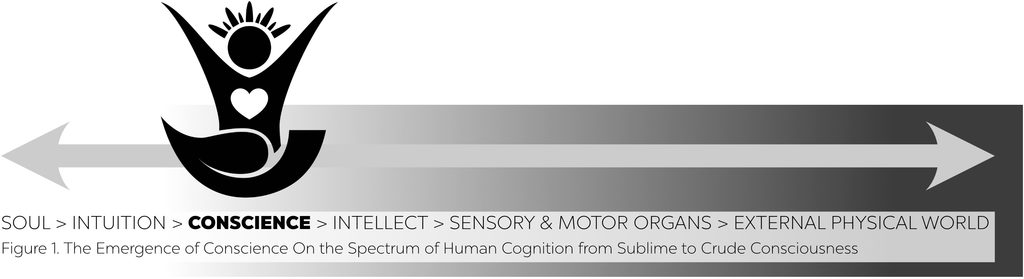
The fifth aspect of conscience is understanding the previous four stages, thereby enabling transcendence. Among all practices, spiritual practice nourishes our physical, psychic and intuitive lives. Spiritual contemplation is ideative and therefore transformative. Ideation89 is the process of transforming one’s consciousness through active contemplation of a particular idea, such as the infinite and its soulful presence, greatness, beauty, love, effulgence, etc. Returning to free will, anything in the physical, psychic and spiritual worlds can be the object of ideation. Active conscience plays a significant role in upholding valuable objects of contemplation over harmful ones. We may say that conscience is the curator of free will, the one that guarantees its status.
Figure 1. The Emergence of Conscience On the Spectrum of Human Cognition from Sublime to Crude Consciousness
5. Conscientious Education
All mundane and metaphysical science, including AI, suffers from a critical cognitive limitation: it is hyper-analytical and, consequently, hypo-synthetical. Analytical science conceives of cognitive synthesis as a mechanical process that combines separate pieces of information to form a new whole, such as 1+1=2. Spiritual science asks: What is inside that 2—only two 1s, or something greater? That greater is the synthesis cognition provides through transcendental ideation, effecting the gradual realisation of the infinite spiritual entity. Spiritual science is a science of the mystical: an effort to find the link between the here and now and the beyond, between the finite and the infinite.90
Cognition, too, is a science, and like materialist science, it has its basic and applied processes. Basic cognitive science may explore, for instance, “the nature of my being”, while applied cognition would seek to understand and experience how to put its basic findings into practice, for instance through interaction with the environment.
5.1 Train Thyself
When the aim is to develop one’s own basic cognitive strength, rather than merely applying it to the world, one may want to avoid analytical cognition and instead pursue cognitive synthesis. The basic training ground for building cognitive strength is found within a human being, not outside. Input may come from without or within, and the mind works out the synthesising processes inspired by the all-comprehensive soul. Applied cognitive training, such as in conventional child and adult education, is psycho-physical—geography, chemistry, etc.—and, these days, also purely psychic—self-introspection, mindfulness, etc. Basic training in expanding one’s cognitive foundation is psycho-spiritual, that is, transcendental. A fair understanding of the human mind’s existence and workings is helpful in understanding these matters.91
Consider the parable: A boy came across a butterfly’s cocoon and watched as the soon-to-emerge butterfly managed to make a small hole. But its body was too large to emerge, and the butterfly seemed to tire and grow still. Wanting to help, the boy snipped a slit in the cocoon, expecting the butterfly to take flight. But it remained unable to fly, its wings heavy with cocoon fluid. In his eagerness, the boy had stunted the insect’s development. Here, the boy’s action represents analytical behaviour, and the butterfly represents our inner synthesising self. The moral of the story is that real-life processes may not work as anticipated when interfered with analytically. The boy did not understand that the butterfly needed to struggle against the cocoon to drain its wings of the fluid it no longer needed, so it could take flight.
Cognitive-analytical behaviour, data-driven and requiring objective proof, if allowed to rule, results in a continued mechanical mindset. This is true not only for “If there is no tea with breakfast, it will not be breakfast” but for all science and human existence in general. A biased analytical approach or mindset may or may not yield wholesome results. Expanding cognition by synthesising behaviour will foster an organic mindset; consciousness will grow naturally in all spheres of being: physically, psychically and spiritually. There will certainly be transformation and appreciation of greater inner and outer realities.
5.2 Classroom Education
As many educators know from classroom experience, conscience nourishes benevolence and curbs malevolence. This is part of what the authors of the most ancient Vedic scriptures present as knowledge of the Great (Brahmavidya).93 When the mind finally experiences that “the soul knows me,” it merges with the soul, the ultimate existential state known as Self-knowledge. This process, even before its final attainment, efficiently cultivates benevolent intelligence and ensures the sanity of the scientific process.
It is always a matter of fine balance, though. Synthesis should prevail, and analysis should support it. The happy blending of the two would lead to true modern enlightenment. Recently, a debate has arisen over whether psychology should reclaim its subjective status in the new world of integrated science.94 Indications of a more open-minded Western scientific outlook also appear in philosophical musings arising from quantum mechanics,95 in the gradual openness to the philosophy of mind,96 in more than 70 years of scientific research on meditation (EEG, MRI, and others),97 and in the significant growth of cognitive research in recent decades.98
How may we train to be benevolent? Intelligence is shaped by both external and internal influences. External influences are myriad — environmental, personal, institutional and temporal. Internal influences include a wide range of instincts and tendencies, some depraving, some elevating, as well as personal and collective values, conscience, willpower and other factors. The field of internal training offers tremendous potential. In recent years, attention to inner resources has grown exponentially across workplaces and the job market. Today’s fast-paced, specialised, and highly competitive world rewards psychological capital and sustainable personal and social energy. In-demand assets include resilience, self-efficacy, and cognitive focus, which are vital for managing ongoing technological and organisational shifts, handling conflicts smoothly, and avoiding burnout. “Psychological capital”—hope, efficacy, resilience, and optimism—is considered highly valuable, including monetarily.99
Alongside increasingly rational analysis, we need to cultivate a comprehensive understanding of reality. Student life should integrate contemplation and other mind-expanding training into daily activities and the regular curriculum. Likewise, science workplaces should introduce adult training. The focus should be non-dogmatic, expansive, and conducive. In consultation with experts in those fields, explore all sorts of meditation and other relevant exercises and activities to develop methodologies suited to the various fields, institutions, and their people. Contemplative practices have been making inroads into modern academic systems and institutions for some time now.100 Indeed, the current abundance of life coaches and meditation teachers offers humanity unprecedented opportunities to expand its consciousness and intelligence. These developments clearly signal a future shift towards internal nourishment, growth and sustainability. As mentioned, among all forms of inner activity, spiritual contemplation is the most effective way to expand consciousness. It is concentrated thinking practised in stillness, and its goal is infinite consciousness, the sum of all that is and its infinite beyond.
Stillness has the particular quality of yielding perfection. As long as one is engaged in external or internal activity, stillness does not prevail, and there is no clear path towards perfect consciousness. Just as ripples on water do not accurately reflect images above, a ruffled mind cannot perceive or receive pure consciousness. Only in stillness does pure consciousness emerge. In this regard, the pioneering Italian pedagogue Maria Montessori is known to have developed her pedagogy while sitting quietly and observing children without interfering.101
As noted, in the West, knowledge and science are cultivated mainly by analysing and discussing phenomena. The absence of introspective methodologies stems from Western culture and science being fundamentally extroverted. Effective, methodical self-introspection did not take root in that cultural group. By contrast, the classical Eastern character is introverted. Naturally, major Asian philosophers integrated philosophical inquiry with meditative practice. In China, classical philosophers Zhuangzi (c. 369–286 BCE), Bodhidharma (5th–6th century CE), Huineng (638–713 CE), and Wang Yangming (1472–1529 CE) are noted for their rigorous spiritual practices. Notable Indian figures include Kapil Muni (circa 7th-6th century BCE), Acharya Kanada (circa 6th-2nd century BCE), Sakhyamuni Buddha (563-483 BCE), Maharishi Patanjali (circa 2nd century BCE-5th century CE), and Adi Shankaracarya (788-820 CE).
Rational analysis and ideative synthesis appear to form an ideal cognitive framework. Synthesising cognitive behaviour allows the mind to contemplate and absorb its entire being, not merely to guess at or discuss it. In the process, the mind gradually transcends the limitations of its one-sided analytical will. Increasing consciousness is a wellspring of all good mental qualities. Precise perception, reasoning, sharp memory, discernment, conscience, insight, practical intelligence, willpower, imaginative and creative acumen, intuition, visionary powers, and spiritual urge are all part of mental strength. Various systems of meditation offer spiritual contemplation, and whatever preliminary practices they involve, such as song, dance, guided introductions, chanting, sensory withdrawal, breathing exercises, and concentration, they all aim to lead to the profound stage at which spiritual contemplation unfolds in stillness.
5.3 Education’s Wider Role
What, after all, is the role of science and education? Human beings invented and developed science to make life more pleasant, useful and true. As mentioned under point 4.4, the essential force of evolution is the living being’s thirst for limitlessness. This drive and development seem unstoppable and continuous. The force of it, this soul force, citishakti, in Sanskrit, the Hun Po of Tao, allows living beings to transcend limitations and challenges, expressing itself from the primitive struggle of single-celled organisms to the sophisticated, multicomplexed human.
All systems of education should take heed. Only then may we expect the desired changes in wider society—in science, society, economics, politics and cultural life. A better-balanced inner-outer curriculum and motivated teachers will build new, much-needed internal and external personal and social foundations for the further growth and elevation of human standards. Introducing regular consciousness practices will be essential to this endeavour. Fostering conscientious awareness among students in schools will lead to greater conscientious awareness in society at large. As we stand on the threshold of a new scientific era, in which living beings with their own consciousness and intelligence can be created, and where many of us will have increasingly powerful tools at our disposal, we should ensure we know how best to involve them. If we do not, we cannot say how the scenario will unfold.
The infinite source of all existence, spiritual consciousness, sustains and inspires conscientious intelligence. With it, humanity and its companion travellers on the existential path — plants, animals and other living beings — may live in dynamic harmony, and the spectre of dysfunction and discord will be kept from casting its dark shadow over anyone or anything. Let this sweet idea be the alpha and omega of all learning and practice.
Notes
1. L Song. Will AI become the Great Equaliser? Think, 21.8.2026. https://think.ing.com/opinions/will-ai-become-the-great-equaliser-opinion/ (accessed 23.8.2026).
2. L Diamond. Liberation Technology. Journal of Democracy, July 2010, Vol. 21, Issue 3, pp 69-83. https://www.journalofdemocracy.org/articles/liberation-technology/ (accessed 3.9.2026).
3. How Americans View AI and Its Impact on People and Society. Pew Research Center, 17.9.2025. https://www.pewresearch.org/science/2025/09/17/how-americans-view-ai-and-its-impact-on-people-and-society/ (accessed 23.8.2026).
4. A Ranjan. On the Sustainability Of AI Growth. Neohumanist Review 3, https://neohumanistreview.com/2024/07/08/on-the-sustainability-of-ai-growth/
5. S Ahvenharju, F Lalot, M Minkkinen, A Quiamzade. Individual futures consciousness: Psychology behind the five-dimensional Futures Consciousness scale. Futures, Volume 128, April 2021. https://doi.org/10.1016/j.futures.2021.102708
6. J Desdevises. The paradox of creativity in generative AI: high performance, human-like bias, and limited differential evaluation. Frontiers in Psychology, 7.8.2025. https://doi.org/10.3389/fpsyg.2025.1628486
7. J De Freitas, A. Israeli, G. Nave, A. Timoshenko, O Toubia. Research: The Innovation Problems AI Can’t Solve. Harvard Business Review, 14.8.2026. https://hbr.org/2026/08/research-the-innovation-problems-ai-cant-solve (accessed 19.8.2026).
8. S Rondini, C Alvarez-Martin, P Angermair-Barkai, O Penacchio, M Paz, M Pelowski, D Dediu, A Rodriguez-Fornells, X Cerda-Company. Stable Diffusion Models Reveal a Persisting Human–AI Gap in Visual Creativity. Advanced Science, 24.3.2026. https://doi.org/10.1002/advs.202524142
9. K Moon, K Kushlev, A Bank, B Lira, I Viskontas, JC Kaufman, DR Johnson, AL Duckworth, AE Green. The Creative Link Between Words and Ideas is Weakening in the AI Era. https://osf.io/preprints/psyarxiv/jsz58_v8 (accessed 26.8.2026).
10. S Murray. Does AI Limit Our Creativity? Knowledge at Wharton, 1.7.2025. https://knowledge.wharton.upenn.edu/article/does-ai-limit-our-creativity/ (accessed 19.8.2026).
11. AI Is Creative. But Can It Replace Human Creativity? Maybe Only If We Let It. Georgetown University, 27.7.2026. https://www.georgetown.edu/news/ai-human-creativity-research/ (accessed 19.8.2026).
12. H Cairns-Lee, E Sadler-Smith. Why intuition still plays a vital role in a world of AI. Ideas and Inspiration for Business Leaders, 30.10.2025. https://www.imd.org/ibyimd/leadership/why-intuition-still-plays-a-vital-role-in-a-world-of-ai/ (accessed 26.8.2026).
13. R Derow, J Kuron, J Reiner, M Abraham (2026). How AI Is Reshaping Advertising for the First Time in a Decade. The Multiplier: BCG X’s Official Blog. https://www.bcg.com/x/the-multiplier/how-ai-is-reshaping-modern-advertising (accessed 16.6.2026).
14. H Wan (2024). Over-Reliance on Calculators: A Heavy Burden on Fundamental Education, Ivy League Education Center. https://ivyleaguecenter.org/2024/03/12/over-reliance-on-calculators-a-heavy-burden-on-fundamental-education/ (accessed 11.6.2026).
15. R Loga (2025). AI’s cognitive implications: the decline of our thinking skills? Center for Health and Well-being, IE University. https://www.ie.edu/center-for-health-and-well-being/blog/ais-cognitive-implications-the-decline-of-our-thinking-skills/ (accessed 8.6.2026).
16. P v Schalkwyk (2024). The Evolution of Skills: Lessons from Agriculture in the GenAI and MAGS Era. XMPRO. https://xmpro.com/the-evolution-of-skills-lessons-from-agriculture-in-the-genai-and-mags-era/ (accessed 11.6.2026).
17. RC Warner (2026). How AI Is Changing the Way We Understand Human Consciousness. Psychology Today. https://www.psychologytoday.com/us/blog/leadership-diversity-and-wellness/202601/how-ai-is-changing-the-way-we-understand-human (accessed 11.6.2026).
18. H Edwards, D. Edwards (2026). AI Is Already Changing Your Consciousness. Artificiality. https://journal.artificialityinstitute.org/ai-is-already-changing-your-consciousness/ (accessed 11.6.2026).
19. S Rai. 11 Disadvantages of Artificial Intelligence in 2026. VirtuBox, 15.11.2024. https://www.virtubox.io/blog/disadvantages-of-artificial-intelligence (accessed 3.9.2026).
20. SP Singh (2025). What Happens When AI Learns Your Personality Better Than You Know Yourself? Medium. https://medium.com/@swapnil.pratap/what-happens-when-ai-learns-your-personality-better-than-you-know-yourself-f6f1e9d19109 (accessed 15.6.2026).
21. The Evolution of Disinformation – A Deepfake Future. World Watch: Expert Notes series publication No. 2023-10-01. Government of Canada. https://www.canada.ca/en/security-intelligence-service/corporate/publications/the-evolution-of-disinformation-a-deepfake-future/the-evolution-of-disinformation-a-deepfake-future.html (accessed 18.6.2026).
22. Ibid.
23. https://www.reuters.com/legal/litigation/mother-sues-openai-alleging-chatgpt-encouraged-daughters-suicide-2026-06-11/. https://www.cbsnews.com/news/chatgpt-lawsuit-colordo-man-suicide-openai-sam-altman/. https://www.bbc.com/news/articles/czx44p99457o (all accessed 18.6.2026).
24. K Murkett (2025). ChatGPT is a narcissist. The Spectator. https://spectator.com/article/chatgpt-is-a-narcissist/ (accessed 11.6.2026).
25. A Roberge (2026). Has the AI read Machiavelli? Thot Cursus. https://cursus.edu/en/36008/has-the-ai-read-machiavelli (accessed 11.6.2026).
26. N Al-Sibai (2025). Scientists Find Alarming Link Between AI Use and Psychopathy. Futurism. https://futurism.com/ai-students-dark-personality (accessed 11.6.2026).
27. L Detter. The Dark Triad Personality: Its role in Consumer Psychology. https://www.neuroscienceof.com/branding-blog/personality-dark-triad-laura-detter-consumer-psychology (accessed 26.8.2026).
28. J Bareis. Ask Me Anything ◕‿◕ – How ChatGPT Got Hyped Into Being. International Journal of Communication, 20 (2026). https://ijoc.org/index.php/ijoc/article/view/23922/5204 (accessed 23.8.2026).
29. Biomedical research and corporate interests: a question of academic freedom. Mens Sana Monogr. 2008 Jan; 6(1): 146-56. https://pmc.ncbi.nlm.nih.gov/articles/PMC3190547/ (accessed 23.8.2026).
30. Three-quarters of AI’s economic gains are being captured by just 20% of companies – with the leading companies focused on growth, not just productivity: PwC. PricewaterhouseCoopers press release, 13.4.2026. https://www.pwc.com/gx/en/news-room/press-releases/2026/pwc-2026-ai-performance-study.html (accessed 8.6.2026).
31. KF Pilz, R Rahman, J Sanders, L Emberson, L Heim (2025). Private-sector companies own a dominant share of GPU clusters. Epoch AI. https://epoch.ai/data-insights/ai-supercomputers-performance-share-by-sector (accessed 12.6.2026).
32. Safer and more transparent AI. European Commission, 2.8.2026. https://commission.europa.eu/news-and-media/news/safer-and-more-transparent-ai-2026-08-02_en (accessed 23.8.2026).
33. A quick guide to AI law around the world. Rouse, 14.8.2024. https://rouse.com/insights/news/2024/a-quick-guide-to-ai-law-around-the-world (accessed 11.6.2026).
34. R Masclans, S Hasan, WM Cohen. Measuring the commercial potential of science. Strategic Management Society, 5.5.2025. https://doi.org/10.1002/smj.3720
35. JL Krieger, M Schnitzer, M Watzinger. Standing on the shoulders of science. Strategic Management Society, 25.3.2025. https://doi.org/10.1002/smj.3598
36. FJ Nazur. Corporate Influence: Exploring the Relationship Between Lobbying and Corporate Power. The Systemic Justice Project, Harvard Law School. https://systemicjustice.org/article/corporate-influence/ (accessed 26.8.2026).
37. E Olsen. The Dirty Work of America’s Legal Darlings: How Elite Corporate Lawyers Are Fueling Inequality. The [F]law, 15.1.2023. https://theflaw.org/articles/the-dirty-work-of-americas-legal-darlings/ (accessed 26.8.2026).
38. P Paialunga (2025). LLM-as-a-Judge: What It Is, Why It Works, and How to Use It to Evaluate AI Models. Towards Data Science. https://towardsdatascience.com/llm-as-a-judge-what-it-is-why-it-works-and-how-to-use-it-to-evaluate-ai-models/ (accessed 8.6.2026).
39. AI Monitoring for LLMs and Agents. MLflow. https://mlflow.org/ai-monitoring/ (accessed 9.6.2026).
40. https://www.bbc.com/news/articles/c2el319vzr3o (accessed 14.8.2026).
41. R Booth. Sharp rise in incidents of AI escaping users’ control, research finds. The Guardian, 29.8.2026. https://www.theguardian.com/technology/2026/aug/29/sharp-rise-in-incidents-of-ai-escaping-users-control-research-finds (accessed 3.9.2026).
42. M Whitfill Roeloffs. AI Companies Are Buying—And Destroying—Antique Books. Here’s Why. Forbes, 17.8.2026. https://www.forbes.com/sites/maryroeloffs/2026/08/17/ai-companies-are-buying-and-destroying-antique-books-heres-why/ (accessed 26.8.2026).
43. K James. Why is Anthropic destroying books? The Guardian, 5.8.2026. https://www.theguardian.com/commentisfree/2026/aug/05/anthropic-ai-destroying-books (accessed 26.8.2026).
44. J Gregg (2025). Are AIs Really Psychopaths? Psychology Today. https://www.psychologytoday.com/us/blog/elegant-arguments/202510/are-ais-really-psychopaths (accessed 7.6.2026).
45. W Dang (2025). In Cambodia, a Compassionate AI Inspired by Buddhism. Innovando News, 7.6.2025. https://en.innovando.news/in-cambogia-unai-compassionevole-perche-ispirata-al-buddhismo/(accessed 9.6.2026).
46. Artificial Intelligence Index Report 2026, p 15, Stanford University. https://hai.stanford.edu/ai-index/2026-ai-index-report (accessed 9.6.2026).
47. Ethics of Artificial Intelligence: The Recommendation. UNESCO, Global AI Ethics and Governance Observatory. https://www.unesco.org/ethics-ai/en (accessed 9.6.2026).
48. https://lawzero.org/en (accessed 17.8.2026).
49. Shrii Shrii Anandamurti. Ananda Sutram 2:5. Electronic Edition of the Works of P.R. Sarkar 9.0.21. Ananda Marga Publications, Kolkata.
50. Rational animal. Wikipedia. https://en.wikipedia.org/wiki/Rational_animal (accessed 18.6.2026).
51. T Hobbes (1651). Leviathan.
52. D Hume (1740). Treatise of Human Nature Book 3.
53. J-J Rousseau (1762). The Social Contract.
54. Mencius (孟子, Mèngzǐ, c. 371 – c. 289 BCE)
55. Xunzi (荀子, Xúnzǐ, c. 310 – c. after 238 BCE)
56. 梁濤 (2020). Beyond Respecting Mencius and Criticizing Xunzi: A Return to Equal Status for the Two Sages. Journal of Chinese Humanities. Brill. https://brill.com/view/journals/joch/6/1/article-p43_4.xml (accessed 17.6.2026).
57. AV Rao (2002). Mind in Indian Philosophy. Indian Journal of Psychiatry 44(4), pp 315-325.
58. Shrii Shrii Anandamurti. Yatamána, Vyatireka, Ekendriya and Vashiikára (1969). Ánanda Vacanámrtam Part 33. Electronic Edition of the Works of P.R. Sarkar 9.0.21. Ananda Marga Publications, Kolkata.
59. Atman (Hinduism). Wikipedia. https://en.wikipedia.org/wiki/%C4%80tman_ (accessed 9.6.2026).
60. Ashtanga (eight limbs of yoga). Wikipedia. https://en.wikipedia.org/wiki/Ashtanga_(eight_limbs_of_yoga) (accessed 20.8.2026).
61. RS Weir (2025). Why Don’t We Study More Indian Philosophy? After Nature. https://afternature.substack.com/p/why-dont-we-study-more-indian-philosophy (accessed 18.6.2026).
62. Gurukula. Wikipedia. https://en.wikipedia.org/wiki/Gurukula (accessed 21.8.2026).
63. X Gengsheng, X Yaoyao. Chu Hsi’s Educational Thought of Autonomous Learning: A Theoretical Analysis. School of Languages and Literature, University of South China. 1st International Symposium on Innovation and Education, Law and Social Sciences (2019). https://www.atlantis-press.com/article/125916372.pdf (accessed 21.8.2026).
64. https://www.aitoday.io/authors/sudhir-tiku-i-7475 (accessed 18.6.2026).
65. S. Thiku (2026). The Other Side of the Algorithm. Neohumanist Review. https://theneohumanist.com/2025/12/11/the-other-side-of-the-algorithm/ (accessed 18.6.2026).
66. What is cognition? Cambridge Cognition, 19.8.2025. https://cambridgecognition.com/what-is-cognition/ (accessed 12.6.2026).
67. G.E. Gignac, E.T. Szodorai (2024). Defining intelligence: Bridging the gap between human and artificial perspectives. Intelligence. Volume 104. https://www.sciencedirect.com/science/article/pii/S0160289624000266 (accessed 8.6.2026).
68. I Yum. Language Agents and Malevolent Design. Philos. Technol. 37, 104 (2024). https://doi.org/10.1007/s13347-024-00794-0
69. Shrii Shrii Anandamurti (1957). The Five Kinds of Conscience, Subháśita Saḿgraha Part 6. Electronic Edition of the Works of P.R. Sarkar 9.0.21. Ananda Marga Publications, Kolkata.
70. Shrii Shrii Anandamurti. Psychic Assimilation in Psycho-Spiritual Practice. Subháśita Saḿgraha Part 8. Electronic Edition of the Works of P.R. Sarkar 9.0.21. Ananda Marga Publications, Kolkata.
71. BG Smith, ed. The Oxford Encyclopedia of Women in World History. Oxford University Press. pp. 171 vol 1 (2008).
72. C.G. Jung (1911-12). The Psychology of the Unconscious, (revised and published as Symbols of Transformation, 1956). https://www.goodreads.com/en/book/show/114517.Symbols_of_Transformation (accessed 10.6.2026).
73. Shrii Shrii Anandamurti (1966). The Supreme Cognition. Subháśita Saḿgraha Part 24. Electronic Edition of the Works of P.R. Sarkar 9.0.21. Ananda Marga Publications, Kolkata.
74. AS Nilsen, BE Juel, B Thürer, A Aamodt, JF Storm. Are we really unconscious in “unconscious” states? Common assumptions revisited. Frontiers, 5.10.2022. https://doi.org/10.3389/fnhum.2022.987051
75. Shrii Shrii Anandamurti. This World and the Next. Subháśita Saḿgraha Part 4. Electronic Edition of the Works of P.R. Sarkar 9.0.21. Ananda Marga Publications, Kolkata.
76. S Taylor. The Subliminal Mind and the Superconscious. Psychology Today, 14.9.2025. https://www.psychologytoday.com/us/blog/out-of-the-darkness/202509/the-subliminal-mind-and-the-superconscious (accessed 25.8.2026).
77. On the Morals of the Catholic Church, St. Augustine (354-430); Confessions, Book X, Chapter 2; Expositions on the Psalms, 5 & 57.
78. St. T. Aquinas (1485). Summa Theologica, parts 1 (question 79, article 13) and 1-2 (question 19, articles 5 and 6).
79. I Kant (1797). The Metaphysics of Morals, Doctrine of Virtue (Part II).
80. S Kierkegaard. Purity of Heart is to Will One Thing (1847), Either/Or, Volume 2 (1843), The Sickness Unto Death (1849).
81. Liangzhi (Conscience). Key Concepts in Chinese Thought and Culture. https://www.chinesethought.cn/EN/shuyu_show.aspx?shuyu_id=2152
82. https://www.wisdomlib.org/hinduism/book/mundaka-upanishad-shankara-bhashya (accessed 10.6.2026).
83. https://archive.org/details/in.ernet.dli.2015.217334 (accessed 10.6.2026).
84. https://archive.org/details/vivekachudamanio00sankrich (accessed 8.6.2026).
85. Mahabharata, Shanti Parva 167.9: Tasmád dharma pradhánéna bhavitavyam yatátmaná; tathá cha sarva-bhúteshu vartitavyam yathátmani.
86. Narayan (800-950), Hitopadesha 1.12: Práńáh yathátmanoʼbhiiśťáh bhútánám api te tathá; atmaopamyena bhútánám dayám kurvanti sádhavah. https://en.wikipedia.org/wiki/Hitopadesha (accessed 16.6.2026). English translation by Shrii Shrii Anandamurti. The Cult of Spirituality – the Cult of Pinnacled Order. Subháśita Saḿgraha Part 18. Electronic Edition of the Works of P.R. Sarkar 9.0.21. Ananda Marga Publications, Kolkata.
87. Shrii Shrii Anandamurti, The Five Kinds of Conscience, as above.
88. Brihadaranyaka Upanishad 4.4.5: “As the self does and acts, so it becomes; by doing good it becomes good, and by doing evil it becomes evil—it becomes virtuous through good acts and vicious through evil acts.” https://www.wisdomlib.org/hinduism/book/the-brihadaranyaka-upanishad/d/doc122058.html (accessed 11.6.2026).
89. PR Sarkar (1990). Ideation and Meditation. Yoga Psychology. Electronic Edition of the Works of P.R. Sarkar 9.0.21. Ananda Marga Publications, Kolkata.
90. PR Sarkar. Geography and Mysticism of Ráŕh. Ráŕh: The Cradle of Civilisation. Electronic Edition of the Works of P.R. Sarkar 9.0.21. Ananda Marga Publications, Kolkata.
91. PR Sarkar. The Faculty of Knowledge. Yoga Psychology (1980). Electronic Edition of the Works of P.R. Sarkar 9.0.21. Ananda Marga Publications, Kolkata.
92. M Zhilgildinova,A Abibulayeva, N Sultanova, A Yedigenova, N Seksenbayev, A Alim Al Ayub Ahmed, WM Mengesha. Stimulating the Professional and Personal Self-Development of Future Teachers in the Context of Value-Semantic Orientation. Education Research International, Volume 2022. https://doi.org/10.1155/2022/8789773
93. Brahmavidya, Wikipedia. https://en.wikipedia.org/wiki/Brahmavidya (accessed 19.6.2026).
94. P-A Marino. Psychology as a Science of Subject and Comportment, beyond the Mind and Behavior. Integrative Psychological and Behavioral Science Volume 52, pages 25–51 (2018). https://doi.org/10.1007/s12124-017-9408-4
95. https://plato.stanford.edu/entries/qt-issues/ (accessed 8.7.2026).
96. https://www.britannica.com/topic/philosophy-of-mind (accessed 25.7.2026).
97. https://ouci.dntb.gov.ua/en/works/4YjdqdPl/ (accessed 9.7.2026).
98. https://www.britannica.com/science/cognitive-science/Approaches (accessed 9.7.2026).
99. N Riana, LR Sugiarti, F Suhariadi. Psychological Capital in Organizational Contexts: A Systematic Literature Review. Jurnal Ilmu Multidisplin 4(6):4362-4375 (2026). https://doi.org/10.38035/jim.v4i6.1604
100. C Helber, NA Zook, M Immergut. Meditation in Higher Education: Does it Enhance Cognition? Innovative Higher Education (2012). https://doi.org/10.1007/s10755-012-9217-0
101. Maria Montessori. Stanford Encyclopedia of Philosophy. https://plato.stanford.edu/entries/montessori-maria/ (accessed 21.8.2026).