Marcus Bussey (PhD)
University of the Sunshine Coast, Australia
mbussey@usc.edu.au
Talk given at the Zonnelicht Early Childhood Centre on its 40th Anniversary, October 29, 2026.
Education is the promise of personal growth for the individual and social cohesion for the collective. It occurs throughout life and has many faces. When formalised, it becomes institutional, which benefits the collective, but it comes at a price for the individual. This is where we need to think about balance and the tug of war, ever present in all societies, between our personal growth and the communities we live in.
Education is an evolutionary tool. Our species has evolved to learn in order to adapt. Language was the key tool in this process, as it allowed us to communicate learning symbolically (Christian, 2003). That was an amazing evolutionary advantage, and of course we know nothing about how this happened, as no one was around 300000 years ago to take notes and make observations. Yet the evidence is in the gradual acceleration of human societies, the tools we made, and the skills we demonstrated as we colonised the planet. Back then the individual did not matter so much. It was the family, clan or tribe, but as complex thought emerged, followed by village and then city life, we became aware of our own inner desires and thoughts.
Stories
One way we can see this process is in the way we told stories. Always telling stories about the weather, the birds and animals, the geology and the stars. The whole lot. That is a magical thing, really, and we still do this. Stories explain things to the collective and also bind the collective together, maintaining personal and collective identity and allowing individuals to add to and modify stories too. Some balance was there.
Today, of course, this balance still exists, but the scales lean heavily toward the institutional. The stories are there too, but they favour this institutional turn despite the evidence to the contrary, as we are a highly individualistic society and we are told all sorts of heroic stories from Hollywood and other parts of the world. Novels too also emphasise the individual: just think of Harry Potter or Katniss Everdeen. Yet this trend comes alongside the powerful presence of modern education, which is highly structured, managerialist and compulsory (Graeber, 2015). I feel we all need a Harry or Katniss to affirm our inner selves in a world that feels stifling to self-expression.
Visual Thinking
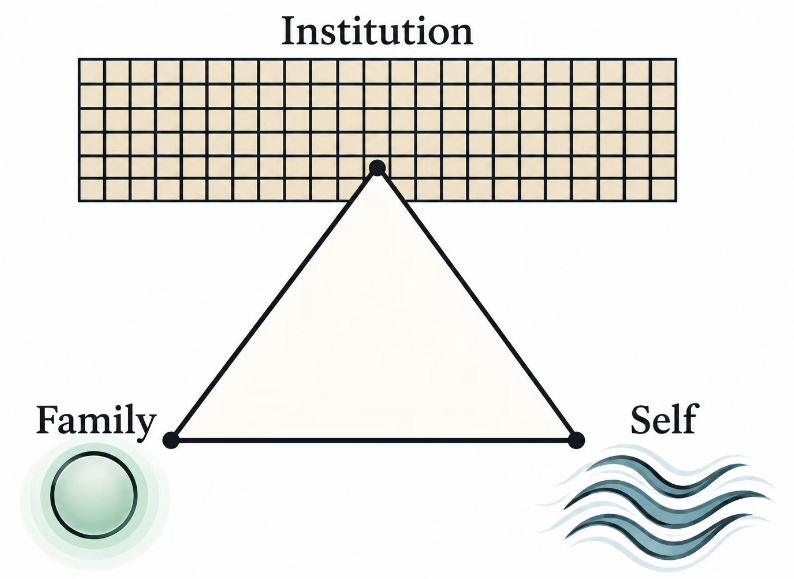
As I think visually, I am going to offer a possible way of understanding this. First, I used the metaphor of the scales above. This suggests a binary, but really, I think it is better to put that image aside and instead think in terms of a triangle that represents the three dimensions of modern education. These sit in tension but also challenge us to seek the compromise needed to let the pedagogical process nurture the individual while affirming family and meeting institutional needs. In this, I see the institutional as a square (think Pink Floyd’s Another Brick in the Wall), whilst the family is a circle (think Heart Circle). The individual is always an emergence. So, I see wavy lines as a flow (think stream). This gives us Figure 1.
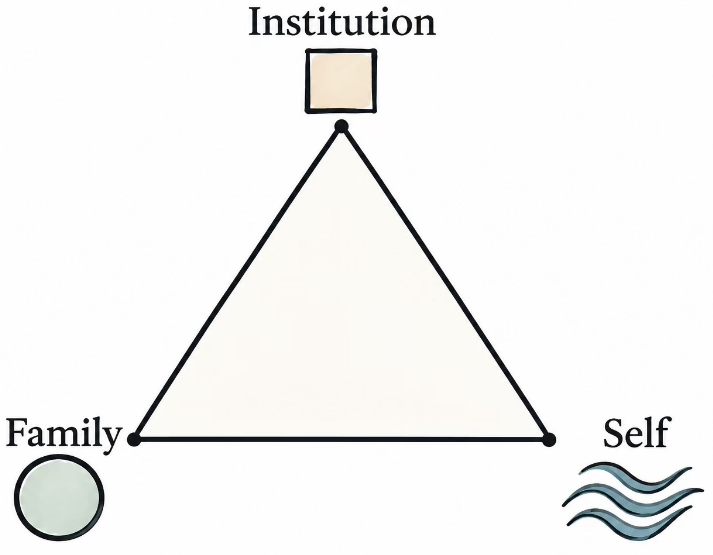
All three have a role, yet power is not distributed equitably among them. The child must submit to both family and institution, so the flow is like a canal being directed and shaped over the individual’s lifetime. The family must nurture the child and offer guidance but must also submit to the State’s powerful legislated demands and its institutional educational priorities, which emphasise conformity and reproduction… again, the reference to Pink Floyd’s Another Brick in the Wall captures this in powerful, though admittedly crude, form.
Temporality & Separation
As we start exploring this relationship, we see different temporalities at work. The first is clock time, which is the institutional time of Modernity. Second, we see cyclic time, which all families experience: children grow and mature, as do their parents, and then they leave to start their own independent lives. Third, the child’s experience of the world is one of flow, as consciousness encounters and absorbs the world around them. This never stops, of course, as we are always in dialogue with the world around us. Table 1 captures something of this, and it raises interesting ethical and pedagogical questions.
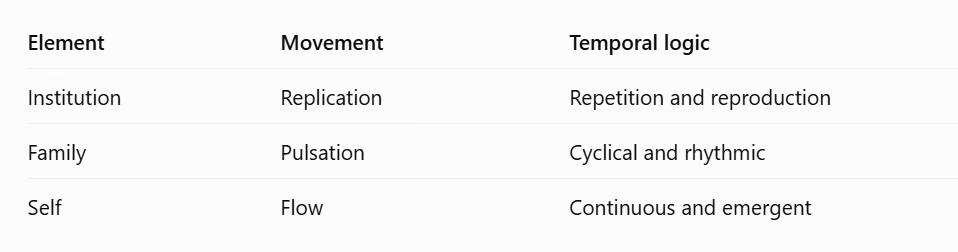
Ethically, we must consider our responsibility to the child’s integrity and that of his/her family. There is no one-size-fits-all here, but when faced with the all-pervasive power of the institutional approach to Modern education, we need to be cautious. Replication is potentially violent and coercive, and inimical to deeper learning and self-realisation. A recurring theme in sustainability discourse is the curse of separation. Our modern society separates to control, codify, explain, and label. Child is separated from child, assessed on specific and limited cognitive abilities, and conditioned to their own separation, even as their instincts tell them they are entangled in great webs of wild and wondrous things (Machado de Oliveira, 2021; Sweetwater, 2025).
Separation shows up in how our world is divided into scholarly disciplines, ethnicities and species, political and religious affiliations, and so on. A category exists for everything and everyone. Finally, the ultimate separation is between body and soul, nature and culture, inner and outer. This is painful. Collectively, it shows up in the ongoing attack on nature and all things different (Morton, 2018). We are afraid of being connected. It feels vulnerable, yet vulnerability makes us human and open to the amazing diversity of life (both human and more-than-human) on this planet. I capture this separation in the box in Figure 1 and in the boxes that replicate it in Figure 2 below. This represents the great enclosure of the human spirit and the planet.
Towards a Reimagining
Separation is a key sustainability issue. One that can be understood through its effects on the planet. The United Nations SDGs speak to this condition and are supported by the equally important balance of the Inner Development Goals. But to return to the child, which is where the next generation of separation starts, there is much we can do.
Reimagining the hyper-institutionalised world of education is central to the ethical reorientation our world requires. Here we are in touch with the Pedagogical Imagination and touching on what many are calling Imagination Activism. Sustainable futures are only achievable if we can overcome separation and adopt a relational, open way of being in the world. So we already have the key ingredient. Learning encounters call for the relational, entangled, and co-creative. Can these be achieved in institutions? I would argue not as currently conceived. But I am reminded that all institutions reflect the key values of the world they represent. In fact, institutions are shaped as much by the world they inhabit as we are. So, a deep shift in ethical orientation is called for, and may even be forced on us by the multiple challenges we face today.
Neohumanism
Following this logic has led me to Neohumanism (Bussey, 2025). It is a philosophy that bridges time and culture, weaving together Western aspirations for a collective humanity with an Eastern perception that we are entangled in multiple flows of consciousness. Neohumanism affirms the positive bond between child, family and society. Yet it sees this relationship as equal and open.
This equality does not discount the parent’s role as guide and mentor to the child, or the child’s role as teacher. It also acknowledges that teaching and learning are context-bound. So familial learning is qualitatively different from school learning. Yet schools cease to be understood, or experienced, as factories seeking to produce a recognisable singular product. Rather, schools become contexts in which the child’s individual qualities are affirmed and developed. The child is an equal participant in this unfolding.
One must never underestimate the child! In a positive learning environment, they tend to expand and flow toward what calls them. The family has its own unique role in this; at times they synchronise, and at other times release in a pulsative process. Balancing inner coherence with individual needs. I believe schools can do this also without losing their role as incubators of tomorrow’s citizens. But being a citizen in a relational world may be experienced very differently. To be a relational citizen means the child’s inner world flows into the natural external with equal vigour as it flows into their community’s cultural world. This is a global orientation. It takes a shift in how we access our humanity.
Global Consciousness
Self-understanding is part of this shift, but it is deeper, taking an explicitly spiritual turn. We need to look inward. That is the neohumanist challenge: to look inward, recognise that, as entangled beings, we are ethically called to love and affirm the world we inhabit, and ACT for the good of all. This is a global paradigm shift with both local and global consequences. I see this as a process, not necessarily linear, that works with soul, vision and action. I frame this as ‘global’ to emphasise that the Neohumanist vision is planetary at scale, but as individuals we are always, and necessarily, local. The local becomes the canvas upon which we paint our world. I capture this in Table 2 below.
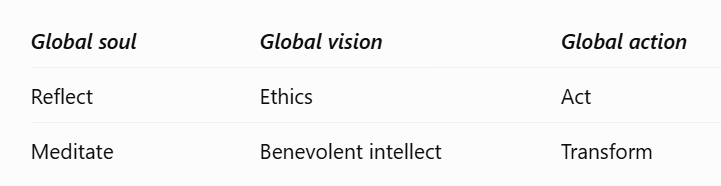
In exploring Table 2, we see that Reflection becomes ethical and supports action in the world. A child becomes reflective by being allowed to attend to the world around them and by being in the presence of adults who are also reflective. There is no age limit to the practice of reflection. When nurturing this with children, I have explored stillness, self-monitoring, being in nature and observing, listening, feeling, smelling and so on. This begins as a very physical practice but moves into the subtle realms of storytelling, memory and imagination. All are practices, actions that constitute world-building (Machado de Oliveira, 2021).
In parallel, meditation is a deepening of reflection, being a practice that invites us into the world of ‘interbeing’ as Thich Nhat Hanh called it (Hanh, 2020). It is essential in fostering a sense of our inner dimensions, which I think of as our secret garden. Most of us have not attended to this garden, and it is overgrown with weeds and thorns. Oh! Such a shame, as this brings sweetness to our lives and nurtures that benevolence of intellect identified in Table 2. The child is receptive to this subtlety when they encounter it in the adults around them. Their flow mirrors it and stores this special process away, sometimes for years, to only re-engage with it when their spirit calls.
To develop a benevolent intellect has two elements. The first assesses the quality of our relationships; the second takes a critical stance in the face of injustice and the twisting of culture, language and politics in ways that serve the interests of specific groups to the detriment of community and planet. This is work that leads to transformation. One way of seeing and being in the world shifts and takes another form. How we understand ourselves, how we practice being in the world shifts. We are perhaps a little less conditioned by the world and more open to ongoing personal and collective growth.
Conclusion
I have no doubt that education has a central role in this process. It promises both personal and collective growth. Currently, it is overly institutionalised and thus a prisoner of a system that values and enforces separation. Our schools certainly are incubators for the future. But what kind of future do you want? What kind of future might a child be called to? And equally, what kind of future do all life forms on this planet yearn for?
We must acknowledge yearning’s role in human life. It shifts according to context, like all human expressions, but ultimately it is spiritual in nature. Calling us into the world of both the seen and the unseen. It invites us into mystery. In this, it plays a powerful role in education, as deep learning involves responding to the curiosity we encounter in the world around us. The world wants to know us, and we want to know it. Here I am paraphrasing both Carl Sagan (2000) and Michio Kaku (2005), while also aligning with the educational vision of people like bell hooks (2003), Parker Palmer (1998), Prabhat Ranjan Sarkar (1982), and Shrii Aurobindo (2022). Teachers can model this yearning by being learners in their encounters with children and, of course, in many contexts, children can lead us in this process. As I said above: Never underestimate the Child!
GenAI
ChatGPT generated all tables and figures.
References
Aurobindo, S. (2022). The Life Divine. New Delhi: Savitri Foundation.
Bussey, M. (2025). Neohumanism, Yearning and Becoming: Essays on Education and Spirituality (Vol. Authors Press): Delhi.
Christian, D. (2003). World History in Context. Journal of World History, 14(4), 437-458.
Graeber, D. (2015). The utopia of rules: On technology, stupidity, and the secret joys of bureaucracy. Melville House.
Hanh, T. N. (2020). Interbeing: The 14 Mindfulness Trainings of Engaged Buddhism. Ypsilanti, MI Parallaz.
hooks, b. (2003). Teaching Community: A Pedagogy of Hope. New York & London: Routledge.
Kaku, M. (2005). Parallel Worlds: The Science of Alternative Universes and Our Future in the Cosmos. London: Allen Lane.
Machado de Oliveira, V. (2021). Hospicing Modernity: Facing Humanity’s Wrongs and the Implications for Social Activism. Berkeley, CA: North Atlantic Books.
Morton, T. (2018). Dark Ecology: For a Logic of Future Coexistence. New York: Columbia University Press.
Palmer, P. J. (1998). The Courage to Teach: Exploring the Inner Landscape of a Teacher’s Life. San Francisco: Jossey-Bass.
Sagan, C. (2000). Cosmic Connection: An Extraterrestrial Perspective. Cambridge: Cambridge University Press.
Sarkar, P. R. (1982). The Liberation of Intellect: Neohumanism. Calcutta: Ananda Marga Publications.
Sweetwater, S. (2025). True Human: Reimagining Ourselves at the End of Our World. Mandala Tree Press.